
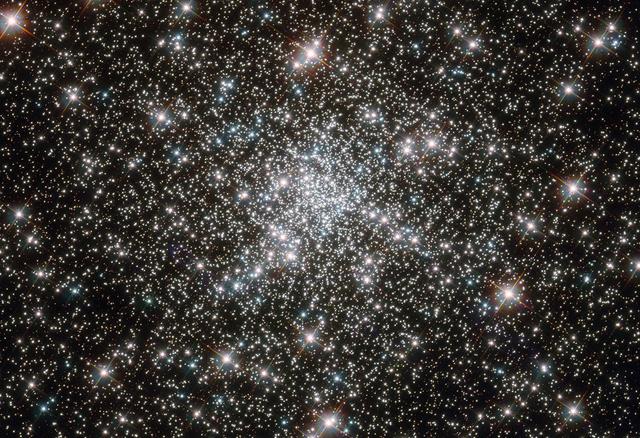
A star's color is mainly a clue to its surface temperature. Hotter stars emit proportionally more short-wavelength light and can look blue-white; cooler stars emit proportionally more long-wavelength light and can look orange or red. Size and brightness are different properties. A cool giant can be far more luminous than a small hot star, so color alone does not tell you how powerful a star is.

Hotter means bluer in stellar light
Dense hot matter emits light across a broad range of wavelengths. As its temperature rises, the balance shifts toward shorter wavelengths. This is why the everyday habit of calling red a warm color and blue a cool color is misleading for stars. Red stars generally have cooler surfaces than blue stars. The Sun's visible light spans the spectrum and looks approximately white from space. Earth's atmosphere, especially along a long path near sunrise or sunset, can make it look yellower or redder. Never look at the Sun to compare its color.
Why there are no vividly green stars
A star that emits strongly in green wavelengths also emits plenty of red and blue light. Our eyes combine the broad mixture into something close to white rather than a saturated green. Stars do not usually behave like a single-color lamp. Their spectra contain many absorption features, but the overall distribution remains broad. Colors in a telescope image may be stretched to emphasize differences, and ultraviolet or infrared observations must be translated into visible colors. A brilliant green patch in an astronomical image may trace glowing gas or an assigned wavelength band rather than a green star.

Color is not the same as apparent brightness
A star looks bright because of its intrinsic luminosity, its distance and how much intervening material dims the light. A nearby modest star can outshine a distant supergiant in our sky. Surface temperature and radius together help determine total luminosity, while distance determines how widely that light spreads before reaching us. Astronomers therefore combine colors, spectra and distance measurements. In a cluster, many stars lie at roughly the same distance, which makes comparisons especially useful. Even there, dust and unresolved companions can complicate the interpretation.
Dust can make a hot star look redder
Tiny interstellar dust grains scatter and absorb short-wavelength light more effectively than longer-wavelength visible light. A star behind dust can therefore appear both dimmer and redder than it would without the dust. This reddening differs from a cosmological redshift, which stretches the wavelengths of spectral features. Astronomers account for both kinds of effect when relevant. They may observe at infrared wavelengths to penetrate some dusty regions, although infrared is not an unlimited window through every cloud. The filter and processing information in an image caption is essential when interpreting its colors.

Compare real stars without buying equipment
On a suitable evening, identify an orange or reddish star and a blue-white star using a current sky chart for your location. Betelgeuse and Rigel in Orion provide a familiar comparison when the constellation is visible. Look when they are reasonably high above the horizon, because atmospheric flickering can introduce misleading flashes. Do not expect bright paint-like colors; human night vision is less sensitive to color at low light levels. A short observing note such as warm orange versus cool white is more useful than trying to assign an exact color name.
Read photographs as measurements as well as pictures
A camera's exposure, white balance and saturation settings can alter the apparent color of a star. Overexposure can turn a colored point into a white blob. Scientific telescope images combine selected filters, and their colors may be representative rather than a faithful simulation of human vision. That does not make them imaginary: the underlying observations are real, but their visual presentation needs explanation. The observational photographs used here illustrate stellar populations and their environments. Follow the linked image records for wavelength and processing details before using any one picture as a temperature chart.
Plan your next observation
For a realistic first session, use our beginner stargazing guide. For the force behind stellar systems and their orbits, read how gravity works.
Sources and image notes
Scientific background: NASA: stars and their life cycles. Each photograph links to its original observation record. Telescope images may combine exposures or assign visible colors to other wavelengths, as identified in the captions. NASA, ESA and the image contributors do not endorse this article or the shopping link below.
Advertisement space reserved. No active advertisement is displayed in this placeholder.
Optional reading and observing supplies
Browse beginner astronomy star atlas on Amazon. This is a product-search link, not a tested-product recommendation; compare suitability and current seller details. No affiliate tag is included.
Leave a Reply