
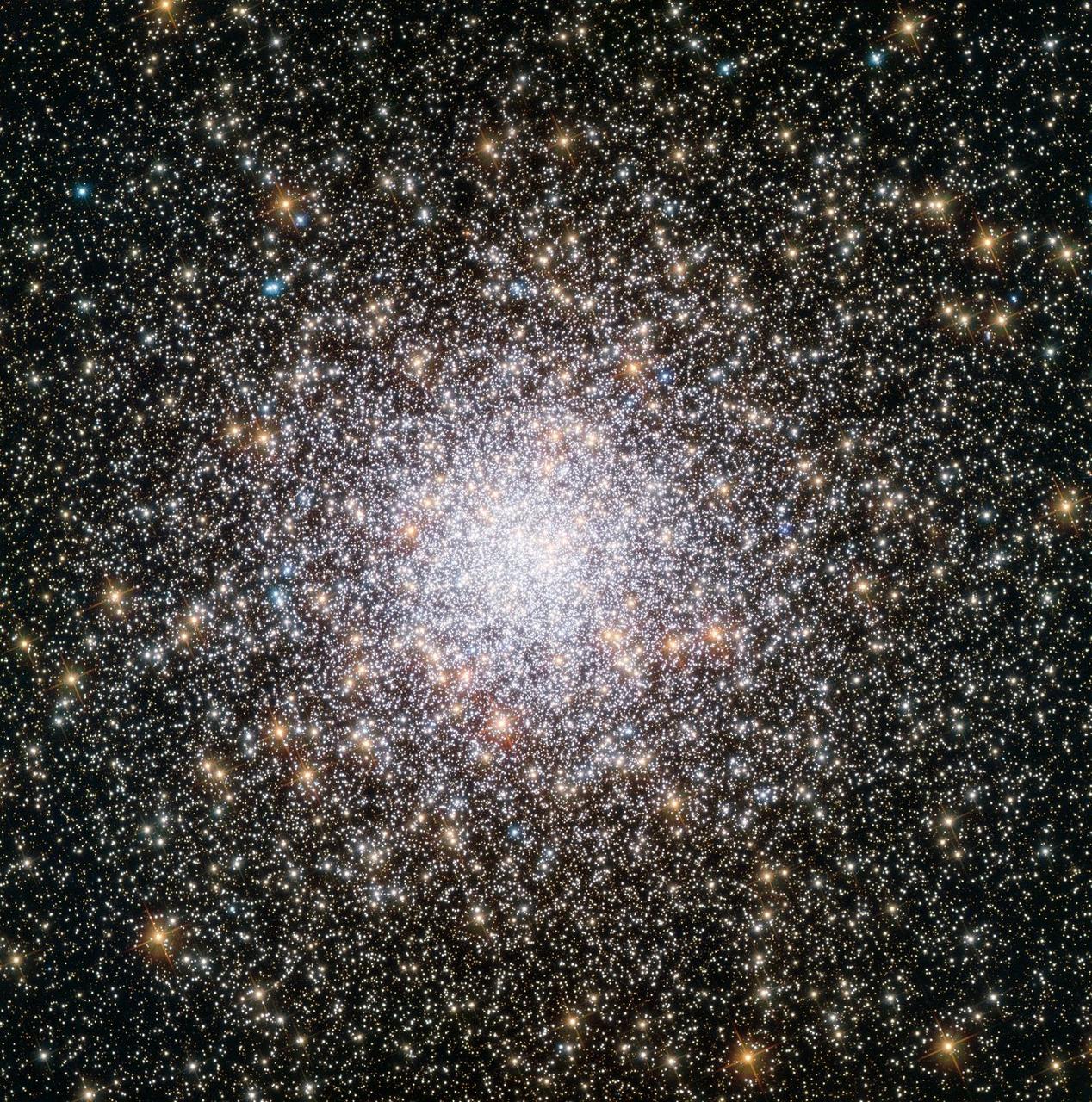
Stars twinkle because their light passes through moving layers of Earth's atmosphere. Patches of air with different temperatures and densities bend the light by slightly different amounts. The star's apparent brightness and position fluctuate, sometimes with quick flashes of color. Astronomers call this scintillation. The star itself usually is not changing brightness on the timescale of the flickering you see from your garden.

A tiny source behind a moving atmosphere
Even a giant star is so far away that it appears almost pointlike to our eyes. Its narrow arriving beam is especially vulnerable to small changes along the atmospheric path. Imagine looking at a small object through water whose surface keeps rippling. The atmosphere is transparent rather than visibly wavy, but its changing refractive properties produce a related distortion. Telescopes collect more light without automatically removing this effect. A large aperture can average some brightness fluctuations, yet atmospheric turbulence still blurs fine detail and makes a star's image dance.
Why stars near the horizon flicker more
Light from a star low in the sky travels through more atmosphere than light arriving from overhead. That longer path crosses more turbulent regions, so the flickering often becomes stronger. Bright Sirius can flash red and blue when it is low, because the atmosphere bends different wavelengths by different amounts. Those rapidly changing colors do not mean Sirius is a flashing aircraft. A steady star's position will shift slowly with the whole sky rather than following the independent track of an aircraft. Check a current sky chart before identifying an unfamiliar object.

Why planets usually look steadier
A planet is close enough to present a tiny disk rather than a virtually pointlike source. Light arrives from many points across that disk, and their fluctuations partly average out. This makes bright planets such as Jupiter look steadier than nearby stars under many conditions. The distinction is useful but imperfect: a planet close to the horizon or seen through strongly turbulent air can shimmer too. Conversely, a high star on a calm night may appear quite steady. Use position, date and a sky chart alongside twinkling when deciding what you are seeing.
Try a simple comparison tonight
Choose a clear evening and compare one bright star high overhead with another low above a distant horizon. Watch each for a minute, then repeat. If a bright planet is visible, include it in your comparison. Record altitude, apparent flicker and any color changes rather than trying to count every flash. Avoid looking across a hot roof, chimney or recently sun-warmed pavement, where rising air can add local turbulence. A view across an open grassy area may be steadier. A cold night is not automatically a stable night; temperature differences and air motion matter.

What astronomers do about it
Space telescopes observe above most or all of the atmosphere and avoid its shimmering. Ground observatories often use high, dry sites where conditions can be favorable. Adaptive optics measures distortions and rapidly changes the shape of a mirror to compensate. This differs from simply sharpening a photograph afterward. Observatories also distinguish seeing, the steadiness of the air, from transparency, how much light gets through. A brilliantly clear sky can still have poor seeing. A telescope brought from a warm room needs time to approach outdoor temperature so air inside it does not add another source of blur.
Twinkling versus a genuinely variable star
Some stars really do change brightness because they pulsate, erupt or are eclipsed by a companion. Those changes are studied with repeated measurements and usually have a different pattern from rapid atmospheric flicker. Comparing a suspected variable with nearby reference stars can help separate real change from passing cloud and other observing effects. The photographs here show actual stellar fields recorded by telescopes; they are not demonstrations of twinkling. Long exposures and image processing change how stars look compared with a live naked-eye view, and cross-shaped spikes usually come from telescope optics rather than the stars themselves.
Plan your next observation
For a realistic first session, use our beginner stargazing guide. For the force behind stellar systems and their orbits, read how gravity works.
Sources and image notes
Scientific background: NASA: stars and their life cycles. Each photograph links to its original observation record. Telescope images may combine exposures or assign visible colors to other wavelengths, as identified in the captions. NASA, ESA and the image contributors do not endorse this article or the shopping link below.
Advertisement space reserved. No active advertisement is displayed in this placeholder.
Optional reading and observing supplies
Browse astronomy binoculars on Amazon. This is a product-search link, not a tested-product recommendation; compare suitability and current seller details. No affiliate tag is included.
Leave a Reply