
Quick answer: Hard, translucent crystals at the bottom of real maple syrup usually mean that some dissolved sugar has come out of solution. The syrup may be too concentrated, or changes in storage temperature may have encouraged crystallization. Sugar crystals by themselves are not the same thing as mold, and syrup with crystals can often still be used if it has been properly stored and shows no signs of spoilage.
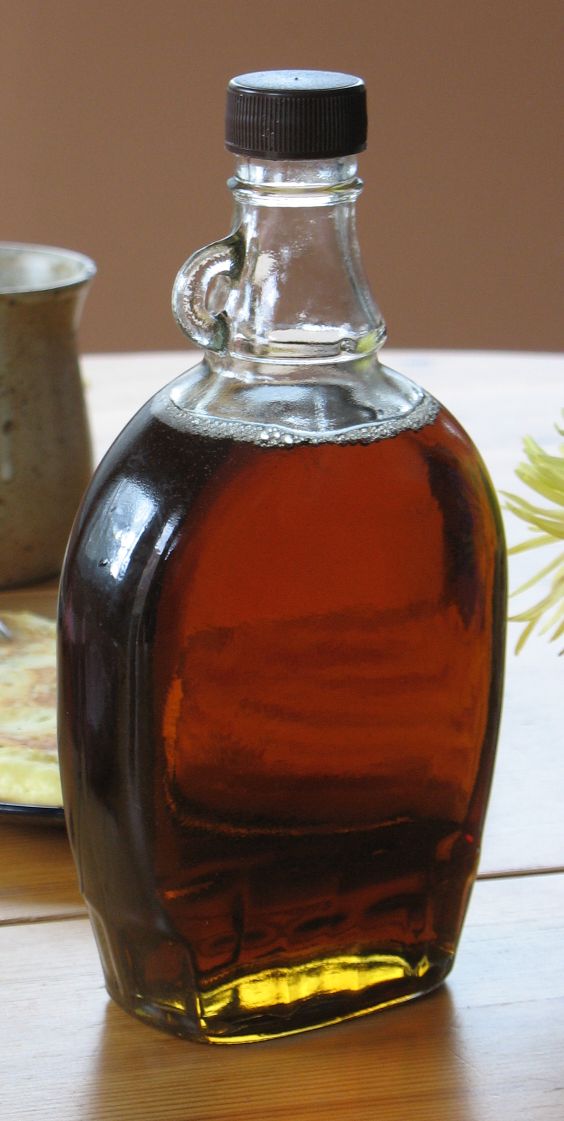
Why maple syrup crystallizes
Maple syrup is mostly water and dissolved sugars, especially sucrose. During production, boiling removes enough water to make a concentrated solution. When there is more sugar than the liquid can comfortably keep dissolved under its storage conditions, sugar may start arranging into solid crystals, often on a rough surface or at the bottom of a glass bottle.
Producers carefully measure syrup density to avoid this. The University of Maine Cooperative Extension maple syrup quality manual explains that syrup above the applicable density range is prone to crystallization. University of New Hampshire Extension similarly warns that overly dense syrup forms crystals at the bottom of a container.
How to recognize sugar crystals instead of sediment
Sugar crystals tend to be hard, glassy or grainy. They may glint in the light, stick to the bottom or break into gritty fragments when disturbed. Maple producers also encounter niter, sometimes called sugar sand: naturally occurring mineral sediment produced during processing. Niter may look more powdery or cloudy than clear sugar crystals. It is distinct from microbial growth.
If you see fuzzy spots, a colored film on the surface, bubbling accompanied by off odors, or anything that looks like contamination, treat the syrup as potentially spoiled. Do not assume every deposit is harmless sugar. Discard suspicious syrup rather than simply scraping off a visible mold patch.
Can you safely dissolve the crystals?
For syrup that was stored correctly and has only ordinary sugar crystals, gently warming the container in warm water can encourage sugar to dissolve again. A heat-safe jar may be transferred to a warm-water bath after its lid is loosened as appropriate; avoid exposing cold glass to abrupt boiling-water temperatures. Stir the syrup only with clean utensils if the container is open. The exact result depends on how concentrated the syrup is: crystals can return if it remains too dense.
Avoid repeatedly boiling the syrup to “fix” it. Boiling removes more water, which can make crystallization worse, and very hot sugar syrup causes serious burns. If you produce syrup yourself, a properly calibrated hydrometer or refractometer is more useful than guessing by appearance.
How should maple syrup be stored?
Follow the manufacturer’s label. Once a bottle of pure maple syrup is opened, refrigerate it in a tightly sealed, clean container. Freezing is also an option for longer storage. Keep crumbs, wet utensils and other food out of the bottle. Homemade syrup needs particular attention to safe processing and clean packaging; sugar content alone is not proof that a batch was handled safely.
Are maple syrup crystals the same as maple candy?
Both involve solid sugar, but the products are made differently. Maple sugar or maple candy is deliberately concentrated and crystallized with controlled heating and stirring. Accidental large crystals in a bottle of syrup are not automatically the same texture as smooth maple candy. For how maple syrup begins in the tree, read why maple sap flows during freeze–thaw weather.
Frequently asked questions
Do crystals at the bottom mean the syrup is expired?
Not necessarily. Crystals mainly indicate a change in how dissolved sugar is distributed. Check storage history and signs of spoilage separately.
Can I eat the crystals?
Ordinary maple sugar crystals are edible if the syrup itself is wholesome. If their identity is uncertain, do not taste them as a safety test.
Will refrigeration prevent all crystallization?
No. Refrigeration is important after opening to help limit spoilage, but concentrated syrup may still crystallize over time.
What if the jar has fuzzy growth on top?
Discard it. Fuzzy surface growth is not normal sugar crystallization.
Bottom line: Clear or hard crystals are commonly a sugar-density issue, while fuzzy growth or off odors are a separate safety warning. Store pure maple syrup correctly and warm crystallized syrup gently rather than boiling it again.
Leave a Reply