
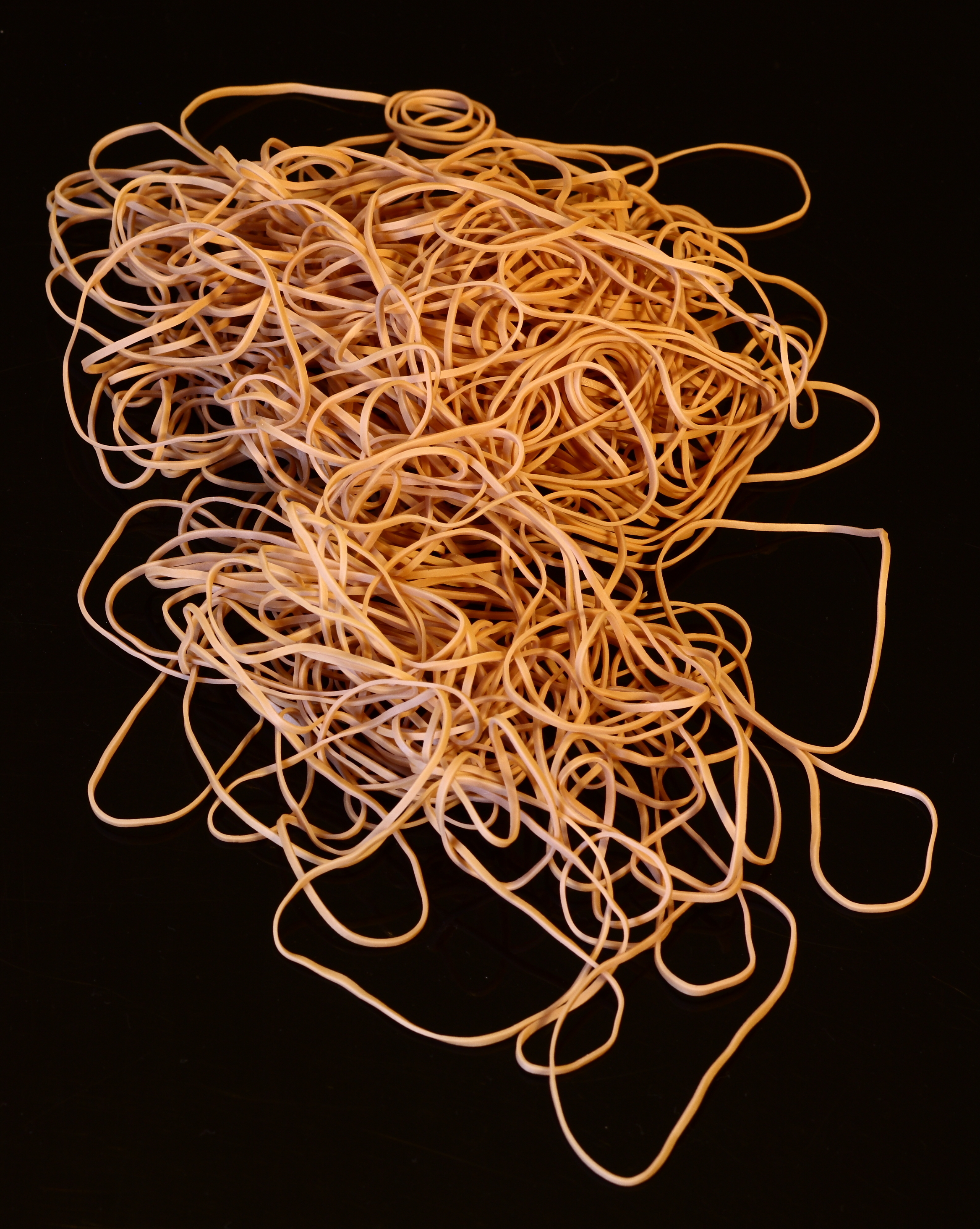
A rubber band seems like a simple spring until temperature enters the picture. Stretch it quickly and it can become slightly warmer. After it has cooled while held stretched, letting it relax quickly can make it cooler. This reversible-looking pair of changes is a clue to what rubber’s long molecules are doing, not merely a consequence of rubbing your fingers together.
Start with the sequence, not just the stretch
The University of Colorado’s chemistry demonstration describes two observations: rapid stretching produces slight warming; rapid relaxation after a pause produces cooling. The pause matters because the stretched band first exchanges heat with its surroundings.
If you compare a band immediately after stretching with the same band long afterward, you are not comparing equivalent moments. Heat can move between the rubber, your hands, and the air. The temperature signal is temporary, so “stretched” does not mean “permanently hot.” The order and timing of the steps are part of the explanation.
Long molecules have many possible shapes
Rubber contains long polymer chains that can adopt many configurations. In a relaxed piece, the chains have numerous ways to bend and coil. Pulling the material constrains those possibilities and makes the chains more extended along the direction of the pull.
Connections between chains help the material act as a network rather than allowing the molecules simply to slide apart. An explanation of rubber elasticity hosted by Oregon State University describes the roles of flexible chains and these crosslinks. A large stretch of the whole band is therefore not the same thing as making every chemical bond proportionally longer.

Entropy is about available arrangements
Entropy is often introduced as “disorder,” but here a more useful picture is the number of molecular arrangements available. Stretched chains have fewer possible configurations than relaxed ones. When the constraint is removed, the network can return toward the much larger collection of coiled configurations. This contribution to the restoring force is called entropic elasticity.
The University of Washington’s discussion distinguishes slow stretching at nearly constant temperature from the quick change that produces a detectable temperature shift. In the slow case, heat can leave as you pull. In a fast stretch, there is less time for that exchange, and the rubber’s temperature can rise. Your hands are doing mechanical work; the band is not producing energy from nothing.
Why this is not the same as bending a paper clip
A paper clip can also become warm when repeatedly bent, but that does not make it an equivalent example. As the University of Houston’s engineering explanation points out, bending metal beyond its elastic limit produces lasting deformation. A warming paper clip and a warming rubber band can reach superficially similar outcomes through importantly different processes.
Real rubber is not a perfect textbook spring either. Its response depends on formulation, temperature, and how far it is stretched. Excessive stretching can damage it. The molecular picture explains a characteristic behavior within an appropriate range, not a promise that every elastic object behaves identically under every condition.
A useful observation does not need a risky test
Some classroom instructions use contact near the lips to detect the small temperature change. Do not stretch or release a band toward your face, and do not use a brittle, cracked, or sticky band for experiments. There is no need to add flames, boiling water, hanging weights, or maximum-force stretching to understand the effect. A supervised demonstration can focus on the sequence and its explanation.
For the separate problem of old bands failing in a drawer, see why rubber bands become brittle in storage. Temporary temperature changes during deformation and long-term material deterioration are different stories, even when the object in your hand is the same.
Leave a Reply