
A bendy straw does more than flex while you hold it. Its corrugated neck can keep a new angle after you let go. That distinction separates an easily bent tube from a structure with several stable shapes.

A fold with more than one resting place
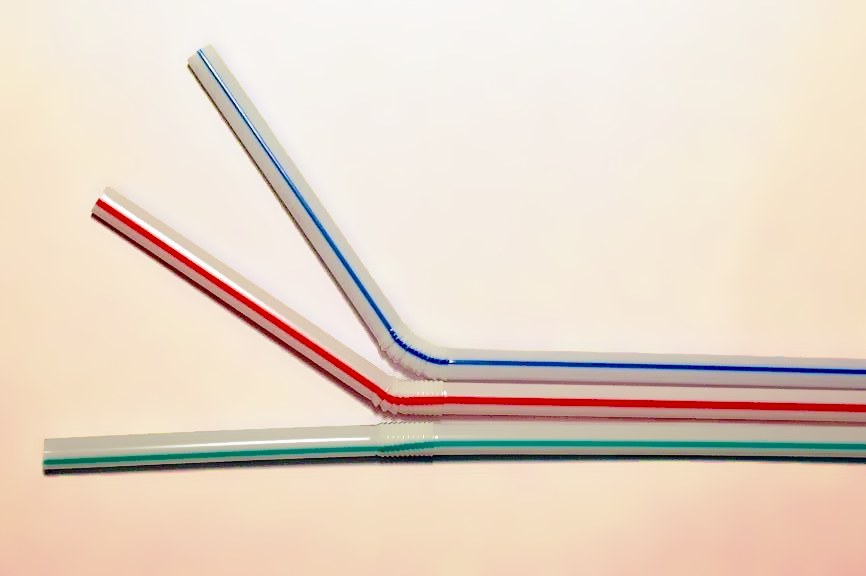
The neck contains repeated, opposing cone-like sections with their tips removed. These thin shells can invert, changing the tube’s length or direction. But a 2018 study by Nicholas Bende and colleagues found that reproducing the corrugated shape in elastic models did not automatically reproduce a stable bend.
The team investigated internal stress. When they slit commercial corrugated structures lengthwise, the walls opened toward a different natural curvature. Closing them back to their original radius restored the stable configurations; closing them at their relaxed radius did not. In their tested structures, the mismatch between the relaxed wall and the closed tube mattered. The ridges were not acting as a simple mechanical latch.
Thickness and creases change the answer
Zhongyuan Wo and Evgueni Filipov’s 2022 investigation examined a broader range of corrugated geometries using simulations, a simplified linkage model, and physical prototypes. For circular two-unit tubes, thinner shells, steeper cones, and weaker connecting creases favored a stable bent configuration.
Their energy calculations explain why flexibility alone is insufficient. Stretching the shell produced an energy barrier followed by a lower-energy region that could support another resting shape. Bending the material added an opposing energy cost. The combined energy landscape determined whether the tube stayed bent or returned.
These results do not make internal stress irrelevant. They show why one explanation should not be applied indiscriminately to every corrugated tube: geometry, wall properties, crease stiffness, and built-in stress all deserve attention. An accordion-like appearance alone does not specify the mechanical behavior.
The ridges also have to fit in a box
Mechanical stability is not the only design problem. In Joseph B. Friedman’s 1951 flexible-straw patent, he described earlier projecting corrugations catching on neighboring straws. Pulling one straw from a bundle could accidentally bring others along.
His proposed design kept the flexible section’s maximum diameter no larger than the smooth end sections. The aim was to preserve an adjustable neck without encouraging adjacent ridges to intermesh. This is a design objective recorded in a patent, not an independent performance test of every straw sold today.
Compare that genuine shape change with a straight straw that appears bent in water. One is a mechanical rearrangement of a thin shell; the other is a change in the path of light.
Leave a Reply