
A vortex ring is a traveling loop of circulating fluid. Laboratory rings reveal both a limit to continued growth and a useful way to deliver controlled gusts.

A ring separates
In 1998 water-tank experiments, Morteza Gharib and colleagues pushed water through a nozzle with a piston. Short pushes produced isolated rings. Longer pushes left a trailing jet: the leading ring stopped accepting circulation continuously from that jet.
Separation occurred near a piston-travel-to-nozzle-diameter ratio of four across their tested conditions. This is a dimensionless ratio, not four seconds or a universal maximum ring size.
A repeatable gust
A 2024 study by Dipendra Gupta and colleagues used a loudspeaker diaphragm to generate air rings. Changing the electrical input adjusted ring speed. Fog imaging and motion of a suspended foam bead provided complementary flow measurements.
The team then perturbed flying soldier flies. Although the gusts were controllable, responses depended on where each insect met the ring. Repeatable airflow did not guarantee identical encounters or recoveries.
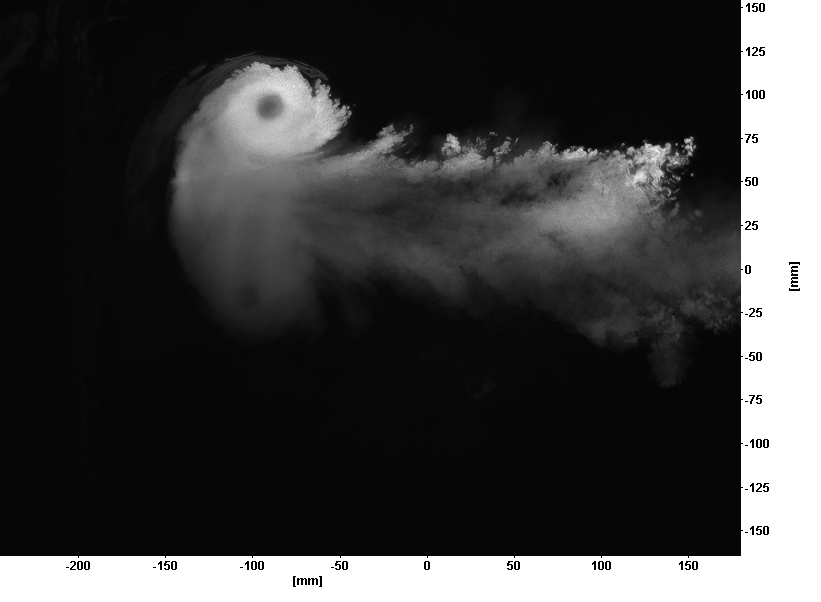
Compare squid jet wakes: animals also produce rings, but laboratory generators isolate particular flow conditions.
Leave a Reply