
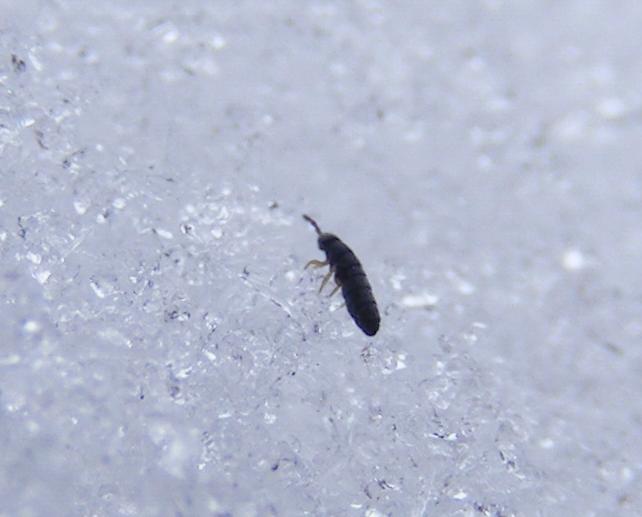
Some tiny springtails remain active around snow. Research on one species revealed proteins that interfere with ice growth, rather than warming the animal.
Stopping crystals from growing
Laurie Graham and Peter Davies collected Hypogastrura harveyi from Canadian snowbanks and meltwater. Their 2005 study found that an extract inhibited ice-crystal growth down to 5.8°C below the solution’s melting point. This was an extract measurement, not a whole-animal survival threshold.
They purified two glycine-rich antifreeze proteins. Growing ice selectively incorporated these proteins, helping separate them from the extract. The larger protein was more active, although less abundant. Both altered crystal growth rather than acting as a source of heat.
Seeing where proteins attach
In a 2010 follow-up, Yee-Foong Mok and colleagues produced the larger protein in bacteria and attached a fluorescent marker. Microscopy showed it binding across ice-crystal surfaces, including the basal plane: one particular face of the crystal.
They also modeled a broad, flat molecular surface that might bind ice. Its greater area offered an explanation for stronger activity, but this was a proposed structural explanation, not a directly measured crystal structure of the larger protein.

For a separate adaptation, explore how springtails jump.
Leave a Reply