
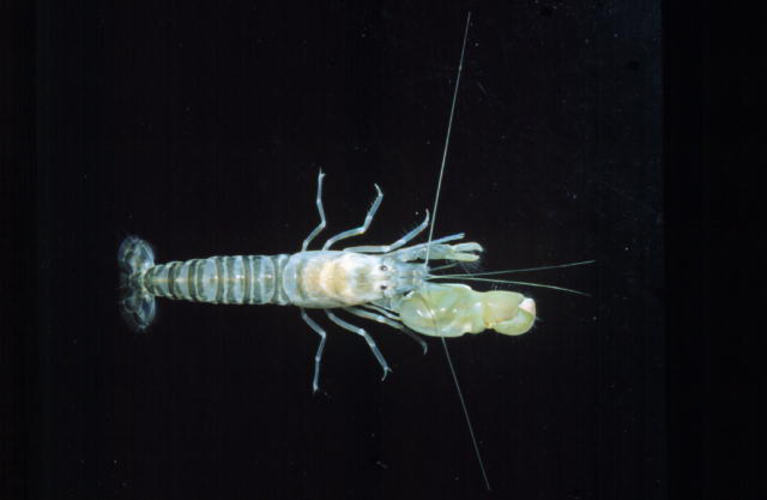
A snapping shrimp makes a surprisingly sharp sound for such a small animal. Its enlarged claw starts the event, but the loud snap is not simply two hard surfaces knocking together. The crucial action happens in the water just outside the claw, where a short-lived bubble grows and collapses.

The sound comes after the claw closes
The specialized claw includes a plunger that moves into a matching socket. Rapid closure pushes out a jet of water. The associated pressure drop allows a tiny bubble to expand; when pressure rises again, that bubble collapses violently. This process is called cavitation. It is not the shrimp blowing an ordinary breath bubble into the sea.
In a 2000 study of Alpheus heterochaelis, researchers synchronized high-speed images with an underwater microphone, or hydrophone. The prominent sound coincided with bubble collapse rather than the instant of claw closure. That timing separated two events which would appear almost simultaneous to an unaided observer. A photograph of a closed claw alone could not establish what made the noise.
A tiny flash is another clue
A follow-up experiment published in 2001 detected a brief flash of light as the bubble collapsed. The authors called it shrimpoluminescence, linking it to the light that can be produced when bubbles collapse under intense acoustic forcing. Here, the shrimp’s claw initiates the process mechanically through its water jet.
The light is evidence of extreme conditions inside a collapsing bubble, not evidence that the whole shrimp or its surroundings become uniformly hot. It also should not be pictured as a glowing animal carrying a biological lantern. The reported light-producing event is localized at the bubble collapse. That is a much more specific claim than saying that snapping shrimp shine.
How does the shrimp withstand the shock?
The resulting pressure pulse raises a second question: what protects an animal that lives among other snapping shrimp? A 2022 study examined the orbital hood, a helmet-like part of the exoskeleton covering the eyes and brain in Alpheus heterochaelis. Researchers compared animals with intact hoods and animals whose hoods had been removed, with additional controls for shock exposure.
After exposure, the unprotected animals took longer to seek shelter and showed impaired motor control. Pressure measurements also showed that the hood reduced shock-wave magnitude. Sealing its front openings weakened that effect, supporting a mechanism involving water being trapped and expelled. The interpretation is a protective structure that redirects and dissipates energy, not an animal immune to every possible shock. These are laboratory findings, not a reason to provoke or handle wild shrimp.
A chorus is not a simple head count
Many snaps together contribute to the crackling sound of coastal habitats. But a noisier recording need not mean that more shrimp have arrived. In temperature experiments published in 2022, shrimp generally snapped more often in warmer treatments. The response also depended on social grouping and time of day.
Those trials were short-term, so they do not establish that snapping will keep increasing indefinitely as oceans warm. They show why listening to a habitat requires context: animal behavior can change the recording even without a population increase. For another coastal animal using a specialized material system, explore the attachment threads that hold mussels to rocks.
Leave a Reply