
A hair hygrometer uses actual hair as its sensor. A mechanical linkage turns the strands’ small dimensional changes into a readable indication. The challenge is not merely making the needle move, but making its position mean something reliable.

Hair becomes the moving part
Hair lengthens as it takes up moisture and shortens as conditions become drier. NOAA’s weather-station activity demonstrates the principle with three strands connected to a freely moving pointer. The hair supplies the changing length; the pointer makes the movement easier to see. In that particular arrangement, the pointer moves down in moist air and up in dry air.
That direction is a property of the linkage, not a universal rule that all humidity needles must follow. Different arrangements can turn the same underlying material response into different motions. The photographed instruments place percentages around a circular dial; NOAA’s simple activity instead records pointer position. A moving pointer alone does not establish the accuracy of a percentage scale.
A small length change needs careful translation
In a 2003 instrument study, M. A. Mehrabian and M. Hashemian used a hair sample held under tension by a spring or small weight. For their sample, the change across the full relative-humidity range was about two percent of its length. That would correspond to roughly two millimeters for a ten-centimeter sample, a scale illustration rather than a specification for any strand you choose.
The researchers connected the hair to a pointer and calibrated its scale, then compared measurements with independent calculations. Their result demonstrates a working instrument, not that every hair has exactly the same response. A sensor, its mechanical arrangement, and its calibration belong together. Replacing the sensing strand with an arbitrary one could change the relationship between pointer position and humidity.
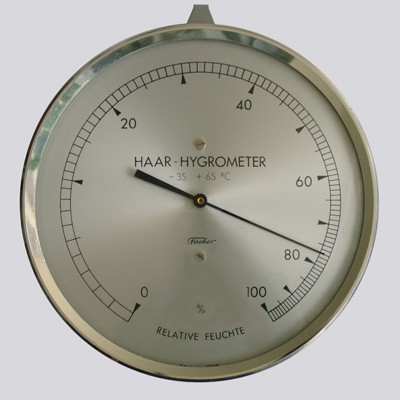
Why a straight scale is not the whole story
The Japan Meteorological Agency’s instrument guide explains that hair length does not change linearly with relative humidity. Its illustrated recording instrument uses shaped cams to translate that response into a more evenly spaced humidity scale. A clock-driven drum carries a chart beneath a pen, converting a sequence of readings into a humidity history. This recording version is called a hygrograph.
The guide also identifies practical limits: contamination, mechanical strain, temperature, and the direction of humidity change can affect the response. Hysteresis means the indication can depend partly on whether humidity has been rising or falling. Do not pull the sensor, bend the pointer, or treat an antique instrument as a ready-calibrated reference. Follow its own instructions rather than improvising adjustments from its appearance.
What the percentage actually describes
Relative humidity compares actual water-vapor pressure with saturation vapor pressure at the same temperature, as the American Meteorological Society defines it. It is not the percentage of the air made of water. Our guide to humidity and dew point explores that distinction in everyday weather.
These instruments also have a long material history. The Science Museum Group’s collection includes an eight-hair Saussure hygrometer made by Richer in Paris in 1789. A familiar biological fiber could become part of a precision ambition: linking an invisible atmospheric property to something a person could watch and record.
Leave a Reply