
A boa can advance without sweeping its body from side to side. In rectilinear crawling, the important movement is partly hidden underneath: belly skin and skeleton move relative to one another.

Pull the skeleton, then recover the skin
Steven Newman and Bruce Jayne combined muscle recordings with movement analysis in their 2018 boa study. When a patch of belly skin held against the ground, one muscle group shortened and pulled the skeleton forward relative to that skin.
During recovery, another group pulled the skin forward relative to the skeleton and ground. A third muscle within the skin helped keep it shortened and stiff during propulsion. Its role was not simply to squeeze the animal forward: resisting stretch helped transmit force.
The cycle depends on coordinated contact, recovery, and stiffness. A nearly straight body is therefore not a motionless body, and the belly is more than a passive protective covering.
A small lift can matter
Hamidreza Marvi, Jacob Bridges, and David Hu filmed three snake species in a 2013 investigation: red-tailed boas, Dumeril’s boas, and Gaboon vipers. They analyzed traveling waves of extension and contraction and built a mathematical crawler model using measured motion and friction.
Local lifting changes which parts rub against the surface. In a modeled comparison using the measured friction conditions for a Dumeril’s boa, lifting increased predicted speed by 31 percent. That number was a model result, not a universal speed boost measured in a live-animal intervention.
The benefit depended on friction. At the model’s highest backward-friction values, lifting no longer improved speed. “Lift more” is therefore not a complete rule: movement depends on the interaction between an animal’s motion and its footing.
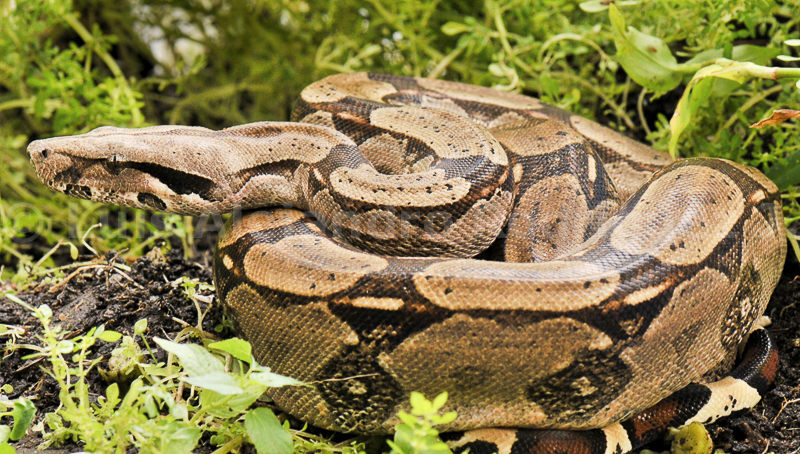
Still moving after a large meal
A 2024 study by Jarrod Petersen and colleagues examined boas after meals weighing 30–37 percent of their body mass. All tested animals could still crawl rectilinearly through the region containing the prey, despite the distended body wall.
Only two of eleven measured movement variables changed significantly: larger cyclic height changes and smaller lengthwise excursions of belly skin relative to the skeleton. The authors suggested these adjustments could limit stretching of the relevant muscles. That is a proposed mechanical explanation, not proof that feeding has no locomotor cost.
Related reading: why earthworms emerge after rain examines another legless animal’s surface journeys.
Leave a Reply