
Goats have wide, horizontally elongated pupils because they are grazing prey animals that need to watch the world around them. The eye shape helps preserve a panoramic view of the landscape, including what is happening to either side, while reducing some interference from bright overhead light. It is an adaptation for spotting danger and moving safely, not an indication that goats see only a narrow strip.
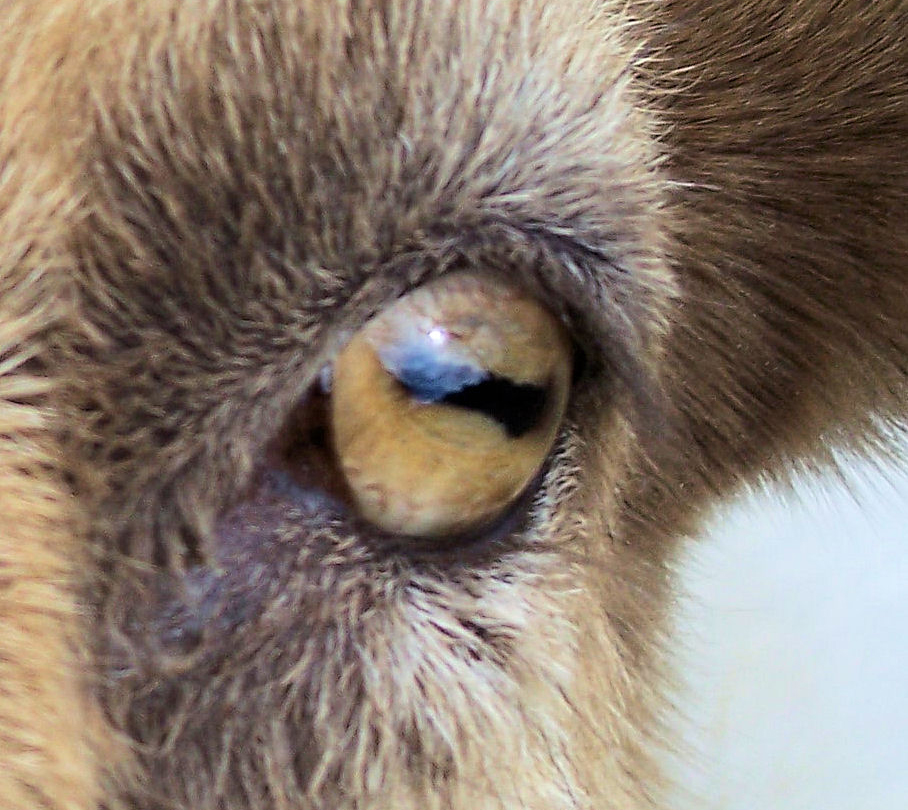
What does the rectangular pupil actually do?
The black opening in the center of an eye is the pupil. It changes size to regulate how much light reaches the retina. In goats, its elongated horizontal shape admits light across a broad side-to-side field. The pupils combine with eyes placed on the sides of the head, producing a wide view of surrounding ground and approaching animals.
Researchers who compared the eyes of more than 200 land species found a strong link between horizontally elongated pupils and grazing animals that are often prey. In contrast, many small ambush predators have vertical slit pupils. This pattern is a correlation between pupil shape and ecological role, not a rule that predicts the eye of every animal.
Why does seeing the horizon matter to a grazing goat?
When a goat lowers its head to eat grass, it must still notice movement across the field. Potential predators may approach from behind or from the side. A broad, horizontally oriented view can help detect movement quickly, with fewer blind areas.
The shape also supports viewing horizontal contours that matter when running over uneven ground. Being able to spot a threat is only the first task; escaping without stumbling is another. Researchers propose that these visual advantages help explain why such pupils evolved among grazing prey species.
Do goat pupils stay horizontal when the head tips down?
Surprisingly, often they do. The eyes can rotate relative to the head as the animal lowers or raises it, helping keep the pupils aligned with the ground. A University of California, Berkeley research team described this compensating eye rotation in goats, antelope, sheep and other grazing animals.
This motion is not a goat doing a trick. It is part of normal visual coordination, much as people make reflexive eye movements to keep the world steady while walking. The remarkable difference is how the grazing animal maintains the orientation of its elongated pupils.
Do goats have better vision than humans?
Better depends on the task. Goats are particularly well equipped to scan a wide area from the sides of their heads. Humans have relatively forward-facing eyes, providing substantial binocular overlap and supporting detailed depth judgments in front of us. Neither arrangement wins every visual challenge.
Goats can see color and have additional adaptations for lower-light conditions. Their horizontal pupils should not be confused with a claim that their vision is black and white. Exact sensitivity varies with conditions and individual animals.
Can you see the pupil shape for yourself?
Observe a calm goat from a respectful distance in natural light. Its pupil should look like a narrow horizontal rectangle or slit, although it becomes broader in dimmer light. Never shine a bright flashlight into an animal’s eyes or restrain it just for a demonstration.
Animal adaptations take many forms. For another example of a body built around survival and energy balance, see why sloths move slowly. The original research on pupil shapes is available from UC Berkeley’s summary of the 2015 pupil-shape research.
FAQ: Rectangular goat pupils
Are goat pupils always the same width? No. Like other pupils, they change size in response to light, but retain their horizontally elongated form.
Why don’t humans have rectangular pupils? Our forward-facing eyes and evolutionary visual demands are different. A round pupil suits a different combination of viewing tasks.
Do sheep have rectangular pupils too? Many grazing species, including sheep and horses, also have horizontally elongated pupils, though their exact eye anatomy differs.
Further reading: UC Berkeley’s summary of the 2015 pupil-shape research; Peer-reviewed study published in Science Advances.
Leave a Reply