
That chalky white film near an ultrasonic humidifier usually comes from dissolved minerals in the water, not ordinary household dust. Some humidifiers send microscopic water droplets into the air. After the droplets evaporate, calcium and other minerals can remain as fine particles on shelves, dark furniture and nearby electronics. The important fix is to reduce the minerals entering the device—not simply wipe surfaces more often.
Why does an ultrasonic humidifier make white dust?
An ultrasonic model uses a vibrating element to break water into a cool mist. The mist can carry dissolved and suspended material from the tank. When airborne droplets dry, those materials do not evaporate with the water. Hard water often causes more visible deposits because it contains more dissolved minerals. The exact amount depends on the water and the humidifier, so two homes can have very different results from the same model.
What kind of humidifier is most likely to make it?
Ultrasonic and impeller cool-mist models are the main types associated with airborne mineral particles. Evaporative humidifiers pass air over a wet wick and generally disperse far fewer minerals. Steam models boil the water, leaving most minerals in the unit rather than sending them into the room. All types still need regular cleaning; fewer mineral particles does not mean a tank cannot harbor microbes.
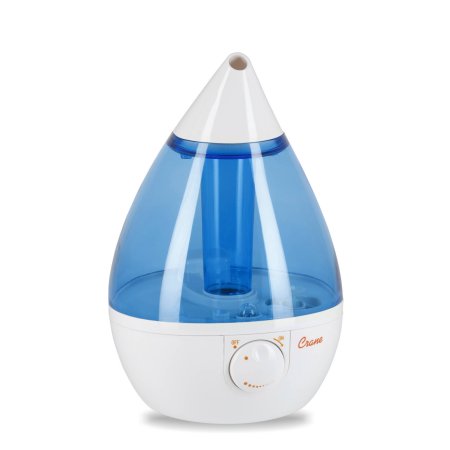
How to reduce white dust without buying a new humidifier
Start with distilled water. Distillation removes much of the mineral content of ordinary tap water. Bottles labeled simply spring or mineral water are not equivalent. Empty, dry and refill the tank according to its instructions instead of repeatedly topping off old water. If your model accepts a demineralization cartridge, check how often it must be replaced; effectiveness varies. Put the appliance on a level, protected surface, and keep the mist outlet away from furniture or electronics. A clean cloth removes existing residue, but it cannot prevent fresh particles if mineral-rich water remains in the tank.
Does a water softener or filtered pitcher solve it?
Not necessarily. A household ion-exchange softener often swaps calcium and magnesium for sodium or potassium; those dissolved solids may still be carried in mist. A carbon filter pitcher usually targets taste and certain contaminants rather than removing every dissolved mineral. Reverse-osmosis water can reduce mineral content substantially, depending on its maintenance and system design. When in doubt, distilled water provides a more predictable starting point.
What humidity level should you aim for?
Use a separate hygrometer rather than guessing from the mist you can see. Excess humidity encourages condensation and can create conditions favorable to mold and dust mites. The U.S. Environmental Protection Agency recommends keeping indoor relative humidity under 50 percent. If windows repeatedly fog or nearby surfaces become wet, reduce output or switch off the device and address ventilation. Don’t aim the unit directly at a wall, curtains or bedding.
Frequently asked questions
Is the white dust mold? Fine mineral residue and mold are different things. You cannot identify an unknown deposit confidently from its color alone. If there are odors, visible growth inside the tank, or respiratory symptoms, stop using the unit and clean it per the maker’s instructions.
Can I add essential oils? Only if the manufacturer explicitly designed the device for them; putting oils in a standard water tank may damage it or change what is dispersed into the room.
Should I descale the humidifier? Yes, following the user manual. Mineral scale inside the device is separate from white dust deposited outside it, but both signal a need for water and cleaning attention.
For a broader buying and maintenance comparison, read our humidifier types and cleaning guide. For another household clue about minerals, see why faucets develop white crust. The EPA humidifier care guidance explains the mineral-dispersion and cleaning recommendations in detail.
Leave a Reply