
A stovetop kettle whistles because escaping steam is forced through a small whistle opening that turns fast airflow into sound. The steam jet becomes unstable, creates tiny vortices and pressure pulses, and the kettle’s whistle amplifies a characteristic pitch. It is not the water itself “screaming.”
What happens inside the whistle?
As water heats in a kettle, vapor forms and escapes through the spout. A whistling design places a cap or specially shaped passages in that path. Research by engineers at the University of Cambridge explains that steam first flows through a narrow opening and emerges as a jet. Small disturbances in that jet interact with another edge or opening, creating vortices and repeated pressure fluctuations. Our ears hear those fluctuations as a tone.
What does a whistle-equipped kettle look like?
The metal assembly near the spout in this photograph is part of a whistling stovetop kettle. Its whistle is a designed airflow passage, not a separate battery-powered alarm.
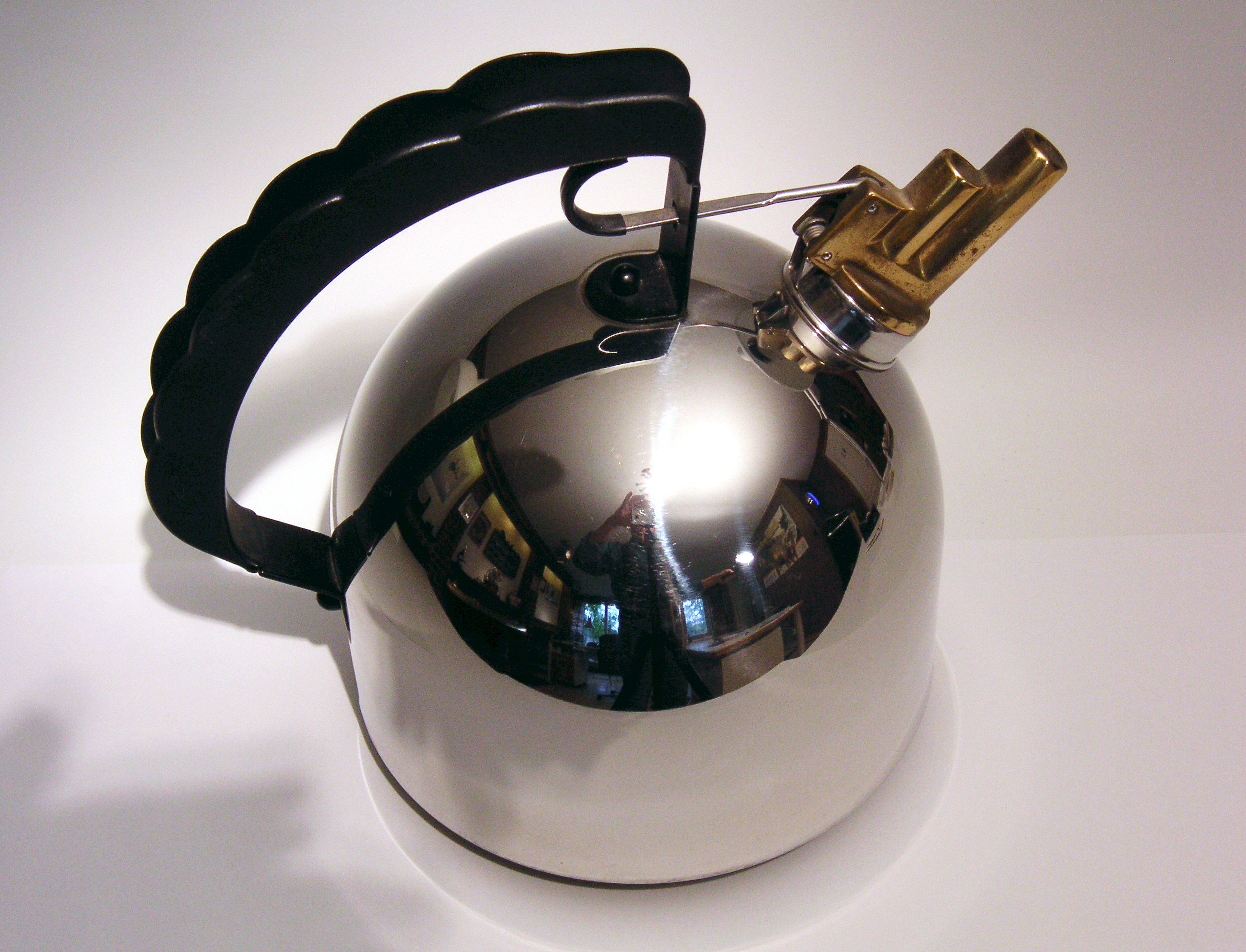
Why does the whistle have a particular pitch?
A kettle is not making completely random noise. Its openings and the length of the passage favor some sound frequencies over others. In that respect, a whistle behaves a little like a wind instrument: the flow creates the vibration, while geometry helps determine which notes stand out. That is why different kettles can have very different whistle sounds even when they heat similar amounts of water.
Does the kettle start whistling at exactly 212°F?
Not always. At sea level, pure water boils near 212°F (100°C), but boiling temperature varies with air pressure and elevation. A kettle starts whistling once enough steam is flowing through the whistle in the right way. That may occur near vigorous boiling rather than at one universal temperature. A lid that leaks steam or an incompletely seated whistle can also change when—or whether—you hear it.
Why is my kettle quiet or making a weak whistle?
Possible reasons include low heat, a loose cap, escaping steam elsewhere, mineral deposits around the spout or a kettle that lacks a whistle mechanism. Allow the kettle to cool completely before inspecting the spout. Never place your face or fingers in the escaping steam, and never seal the vent to try to make it louder.
Are electric kettles and stovetop kettles the same?
No. Many electric kettles use a thermostat or automatic shutoff rather than a steam whistle. Some models play an electronic tone to signal completion. In either case, follow the manufacturer’s water-level instructions; our guide to electric kettle minimum and maximum fill lines explains why they matter.
Frequently asked questions
Why does the kettle whistle louder as the boil strengthens?
Stronger heating can increase steam flow through the whistle, producing a more intense sound. The exact relationship depends on the particular whistle shape.
Can I use a kettle without its whistle cap?
Only if the manufacturer’s instructions permit it. A missing cap may mean no audible warning that the water has boiled.
Will a kettle whistle if the water runs dry?
Do not rely on it. Dry heating can damage a kettle and create a fire or burn hazard; never leave a stovetop kettle unattended.
Leave a Reply