
A wheeled cart would weigh roughly one-sixth as much on the Moon, but that does not mean it would take one-sixth the effort to start, accelerate or stop it. Gravity changes its weight and the force it presses onto the ground; its mass and inertia remain essentially the same.
Separate vertical weight from sideways acceleration
Weight is the gravitational force pulling the cart down. On Earth a 30 kg cart weighs about 294 newtons; on the Moon it would weigh around 49 newtons. But to accelerate that same 30 kg cart sideways at 1 meter per second squared, Newton’s second law still calls for about 30 newtons of net horizontal force, before accounting for wheel and ground resistance.
Real wheeled vehicles have operated on the Moon
The Apollo lunar roving vehicles carried astronauts and equipment over uneven regolith. Their wheels, traction and suspension were engineered for that terrain; no ordinary supermarket cart is designed for dusty, vacuum-exposed lunar ground.
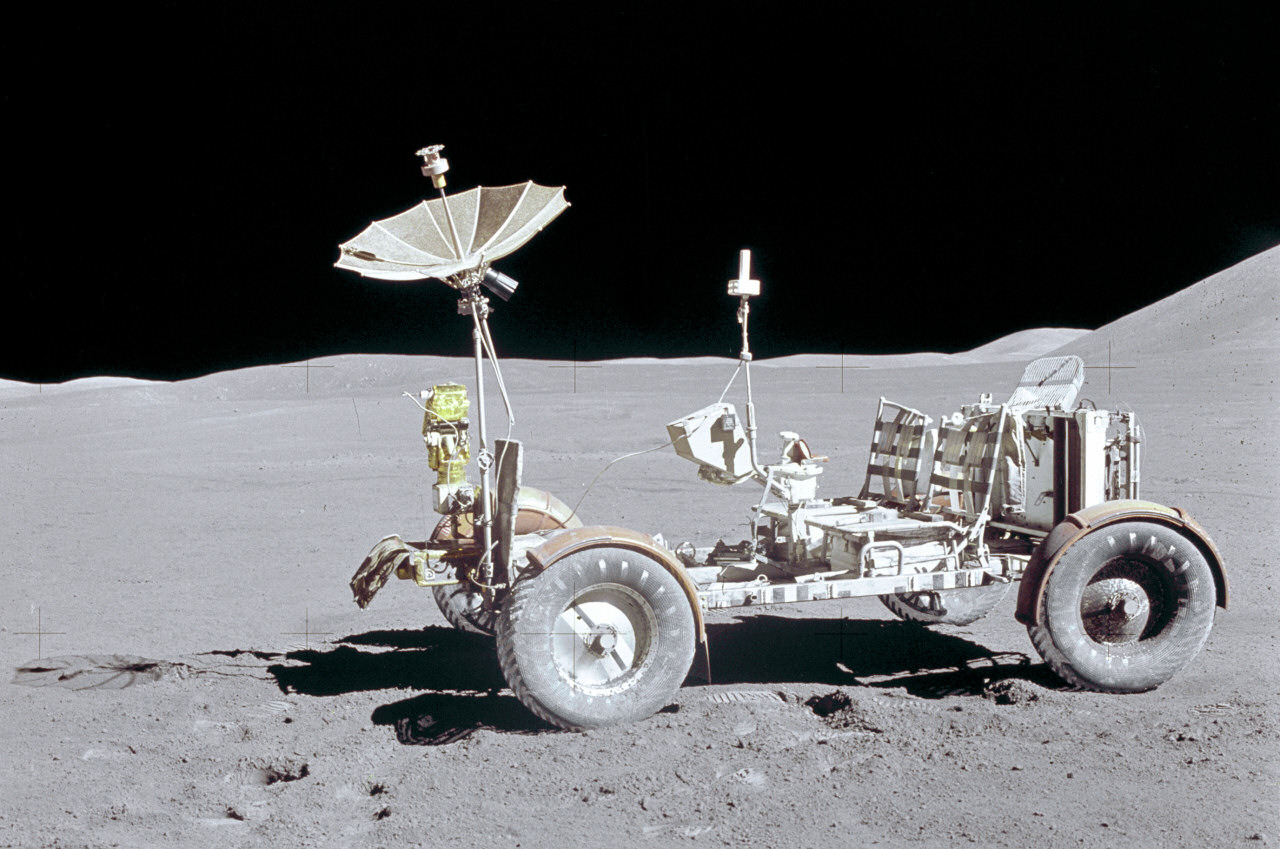
Why lighter weight can help and hurt
Reduced normal force can reduce rolling resistance on some surfaces, but it can also reduce the friction available for traction and braking. Loose lunar soil can make wheels sink, slip or dig in. The result depends on wheel shape, load, soil compaction and speed rather than on gravity alone.
A hypothetical comparison you can calculate
Suppose a cart has mass 30 kg. On Earth its weight is about 30 × 9.81 = 294 N. On the Moon it is 30 × 1.62 ≈ 49 N. Either way, changing its speed by 1 m/s in one second requires roughly 30 N of net force. That simple calculation ignores wheel friction, slope and any operator, so it is not a prediction of a real rover’s motor demand.
Frequently asked questions
Would a cart coast forever on a flat Moon?
No. Wheels still experience bearing losses, soil deformation and other resistive forces. Without air drag, one source of resistance is reduced, not all of them.
Does a rover have less momentum on the Moon?
Not at the same speed. Momentum is mass times velocity, and the mass does not change with location.
NASA discusses realistic wheel-and-soil challenges in its lunar rover mobility overview. For a related example, read lunar rover weight versus mass.
Leave a Reply