
A total lunar eclipse turns the Moon reddish-orange because the light that reaches it has been filtered through Earth’s atmosphere. Earth blocks the direct sunlight, but some sunlight bends through the atmosphere around our planet and enters the shadow. Blue light is scattered away more efficiently, while a larger share of red and orange light makes it through. The result can look like a copper penny, rusty orange, or a deep red Moon.
What actually happens during a total lunar eclipse?
The Sun, Earth and Moon line up with Earth in the middle. The full Moon moves into the darkest central region of Earth’s shadow, called the umbra. Because Earth’s atmosphere lets some sunlight through, the eclipsed Moon usually does not vanish completely. Instead, it glows dimly with light that has passed through the ring of air around Earth’s curved edge.
See the red Moon during totality
NASA’s lunar eclipse image illustrates the Moon’s copper-red appearance during totality. The bright red color is not caused by an actual change to the Moon’s rocky surface. It is a temporary change to the sunlight illuminating that surface.
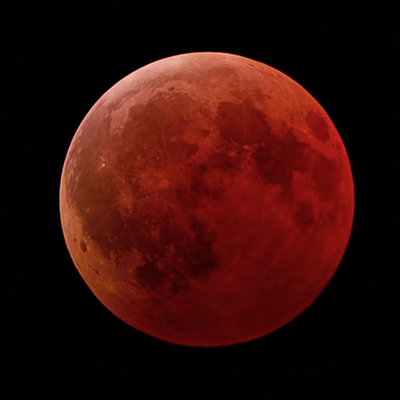
Why does the atmosphere favor red light?
Sunlight contains many colors. As it passes through Earth’s air, molecules scatter short-wavelength blue and violet light more strongly than the longer-wavelength reds and oranges. You see a related effect at sunrise and sunset, when sunlight travels through a long stretch of atmosphere and the Sun often appears warm-colored. During an eclipse, light that grazes Earth’s atmospheric rim can be refracted and redirected into the planet’s shadow toward the Moon. In that sense, the red Moon is being illuminated by sunlight from around the world’s sunlit edge.
Why is one lunar eclipse dark red and another bright orange?
Each eclipse can have a different color and brightness. Atmospheric clouds, aerosols, volcanic dust and the exact path the Moon takes through Earth’s shadow can all matter. When the Moon goes deep into the umbra it often looks darker than it does near the shadow’s edge. The appearance may also vary as the eclipse proceeds; don’t expect every “blood Moon” photograph to match the next one.
Why doesn’t every full Moon become eclipsed?
The Moon’s orbit is tilted about five degrees relative to Earth’s path around the Sun. At most full Moons, the Moon passes above or below the darkest portion of Earth’s shadow. A lunar eclipse requires the right alignment near one of the places where the orbital planes cross, called nodes. This is why eclipses occur in seasons rather than every month.
Can you watch a lunar eclipse safely?
Yes. Unlike a solar eclipse, a lunar eclipse is safe to view directly with the naked eye. Binoculars or a telescope can reveal more surface detail, but neither is required. Choose a spot with an unobstructed view of the Moon and check the timing and visibility for your location. If the sky is cloudy, even a perfectly timed eclipse may be hidden.
Total, partial and penumbral eclipses: what’s different?
Total: The whole visible Moon enters Earth’s umbra and typically glows red-orange. Partial: Only part of it enters the umbra, making a curved dark bite in the lunar disk. Penumbral: The Moon passes through Earth’s lighter outer shadow; the dimming may be subtle enough to miss at first glance.
Frequently asked questions
Is a blood Moon dangerous?
No. “Blood Moon” is an informal description of the color. It does not signal a physical danger or a change in the Moon’s composition.
Will the red Moon look equally red everywhere?
No. Observers may experience different sky conditions, and cameras often exaggerate or change color through exposure and processing. The Moon’s color and brightness also shift during an eclipse.
Is a lunar eclipse the same as a new Moon?
No. A lunar eclipse happens at full Moon, with Earth between the Sun and Moon. A new Moon occurs when the Moon lies near the Sun’s direction in our sky and its sunlit side mostly faces away from us.
Learn more: Test why the rising Moon looks huge and discover the bright rays around Tycho crater. NASA also explains how Earth’s atmosphere changes an eclipsed Moon’s color.
Leave a Reply