
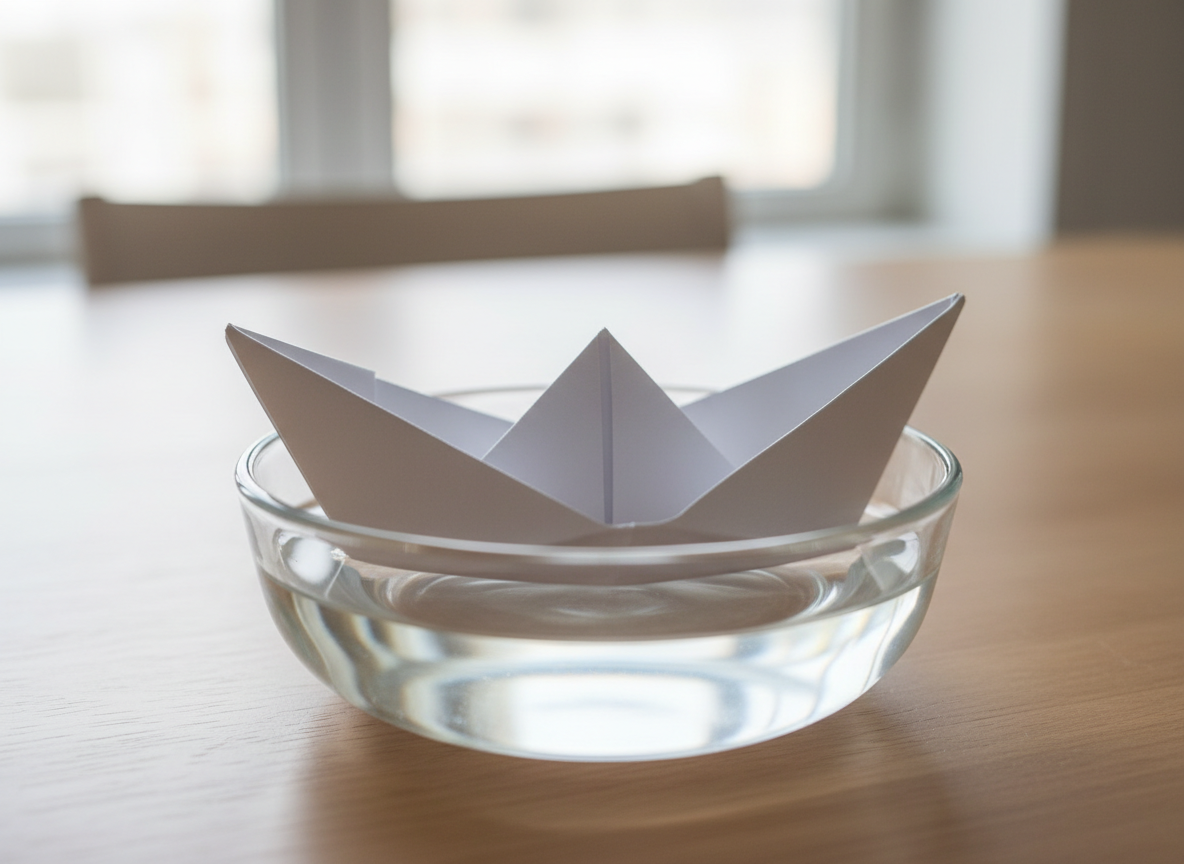
To keep a folded paper boat upright, make the two sides symmetrical, open the base wide enough to form a stable hull, and place it gently on still water. A boat that leans usually has an uneven fold, a pinched base, or water soaking into one side faster than the other.
1. Check that both sides match
Set the finished paper boat on a dry tabletop. Look straight at the bow and stern. The peaks should be centered, the left and right sides should have similar slopes, and the bottom edges should touch the table evenly. If one side is noticeably shorter, reopen the last fold and realign the edges before creasing again. Firm, even folds help the boat hold its shape.

2. Open the bottom to make a stable base
Gently separate the hull’s lower edges so the boat has a broad, flat-enough footprint instead of collapsing into a thin ridge. Avoid forcing the top point outward until it tears. A taller boat is not automatically more stable; if it keeps falling sideways, widen the base a little and test again. The goal is a centered hull that sits low and balanced.
3. Start with still water
Fill a shallow basin or tray with clean water, leaving enough room to reach the boat easily. Lower the boat straight down with both hands, then release it only after the base touches the surface. Do not throw or push it into the water. Wait a few seconds before making adjustments: ripples from your hand can temporarily rock even a well-folded boat.

4. Adjust the side that leans
If the boat tips toward one side, lift it out and put it back on a towel. Check for one side folding inward, a crooked center line, or a waterlogged flap. Reopen and square up the base while the paper is still workable. If a section is soft or torn, start fresh with a dry sheet; repeatedly squeezing saturated paper usually makes the shape worse.
5. Keep added weight centered
For a small science experiment, add one lightweight object at a time near the middle of the boat, not at the pointed ends. Watch whether the hull settles evenly. Stop when the paper touches the waterline too deeply or begins to soak through. Use small, dry items that can be retrieved safely; avoid batteries, sharp objects, or anything that would pollute the water. An adult should supervise younger children around even a shallow basin.
Which paper works best?
Ordinary printer paper is easy to fold and good for a short experiment. Thin newspaper becomes wet quickly; very stiff cardstock may resist the required folds. A paper boat is temporary because ordinary paper absorbs water. To compare designs fairly, use the same paper size, water depth, and test time. Record which boat stays upright longest rather than assuming one fold guarantees success.
Troubleshooting common problems
Boat flips immediately: Check if the base is too narrow or one side is folded differently. Boat floats at first, then tilts: One flap may be soaking up water; switch to a fresh dry boat. Boat spins but stays upright: That can be normal if the water has a current; repeat the test with still water. Boat sinks after adding a coin: Reduce the load, center it, and test a sturdier, more symmetrical fold.
Related guides
If you need the starting folds, use our step-by-step paper boat tutorial. To understand the science, read why a paper boat floats before it gets soggy.
Frequently asked questions
Do I need to waterproof the paper? No, not for a short balance test; ordinary paper is enough. Should I tape the bottom? Tape can change the weight and shape. If you’re comparing designs, use the same amount on every boat. Does the largest boat always stay upright longest? No. Symmetry, base width, paper stiffness, and water absorption all matter.
Leave a Reply