
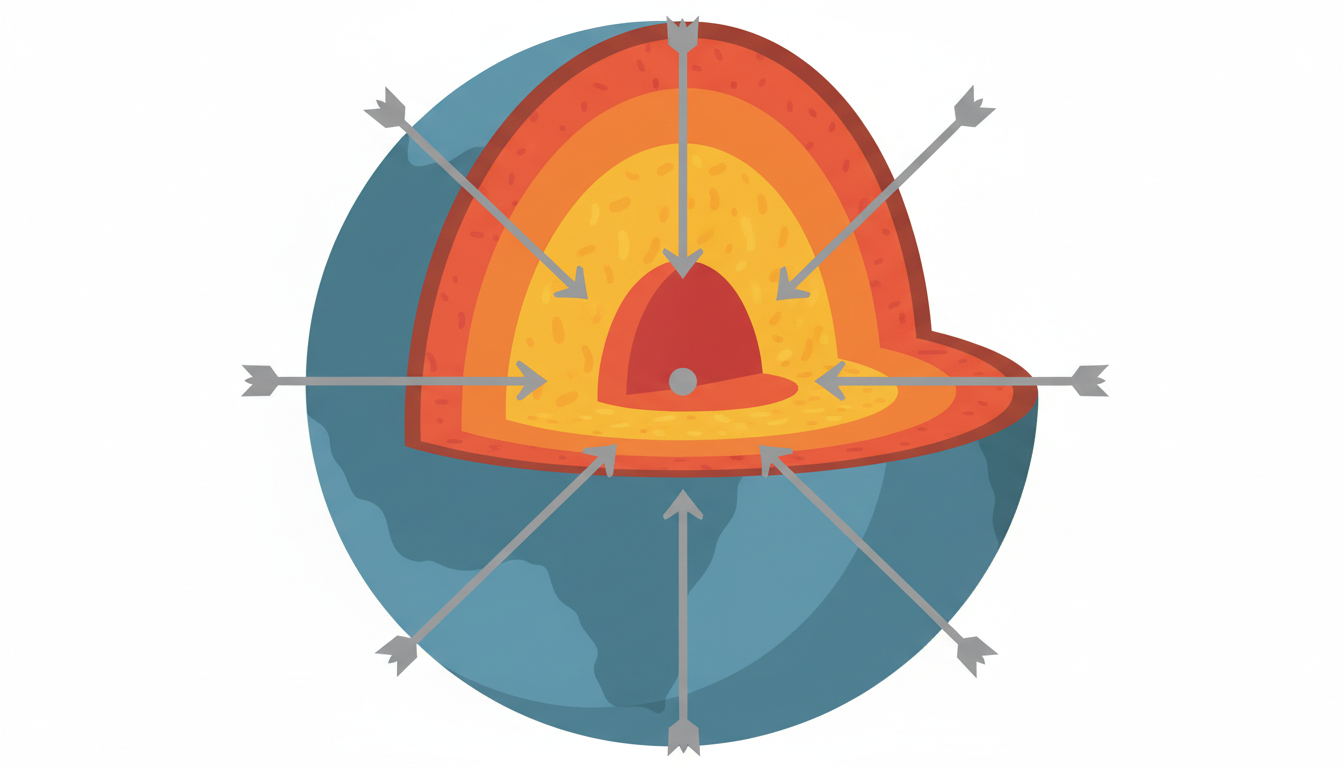
At the exact center of an idealized, spherically symmetric Earth, the planet’s net gravitational pull is zero. That does not mean gravity has stopped existing. Every surrounding piece of Earth still attracts you, but the pulls balance in every direction. This is a physics thought experiment—not somewhere a person could travel.

How can gravity cancel if Earth surrounds you?
At the surface, most of Earth’s mass is below your feet, so the combined gravitational force points toward the planet’s center. At the exact center, however, mass surrounds you on every side. For every inward gravitational contribution in one direction, a matching contribution in the opposite direction cancels it, provided Earth is sufficiently symmetrical.
You can think of the result in terms of the shell theorem: for a spherical distribution of matter, material in shells outside your distance from the center contributes no net gravitational force at your location. Only the mass within your radial distance contributes to the net pull toward the center.
What happens to gravity as you descend?
In a uniform-density Earth model, gravitational acceleration falls in direct proportion to distance from the center; halfway to the center, it would be half the surface value. But the real Earth is not of uniform density. Its core and mantle have different densities, so the real interior profile is more complicated: gravity is approximately constant through much of the mantle and changes more sharply deeper down. The precise central result remains zero for the ideal symmetric model.
What if there were a tunnel straight through Earth?
Imagine a perfectly straight tunnel from the North Pole through Earth’s center to the South Pole. Ignore air resistance, planetary rotation, immense pressure and heat, and the impossibility of keeping such a tunnel open. Dropped from one end, an object would speed up as it falls toward the center. Its acceleration gradually changes direction and its instantaneous net gravitational force is zero exactly at the midpoint, but it is moving fastest at that moment in the ideal model.

After passing the midpoint, gravity pulls back toward the center, slowing the object on the far side. In a perfectly frictionless model, it would oscillate. Real tunnels would face crushing pressures, very high temperatures, drag and other practical impossibilities.
Is this the same as feeling weightless in orbit?
No. Astronauts on the International Space Station still experience substantial Earth’s gravity. Their floating sensation is caused by continuous free fall around Earth, rather than the cancellation of Earth’s gravitational field at a central point.
Frequently asked questions
Would gravity be zero anywhere else on the planet?
Not simply because you are underground. The exact zero at the center arises from the ideal symmetry. In real geology, local variations in density also influence the field.
Could someone stand at Earth’s center?
No. Earth’s interior is enormously hot and under high pressure, and there is no cavity to stand inside. The question is useful for learning gravitational physics, not for designing a journey.
Reliable reading
See NASA’s explanation of gravity at Earth’s core, PBS NOVA’s gravity-at-the-center thought experiment and the American Association of Physics Teachers’ discussion of Earth’s interior gravity.
Leave a Reply