
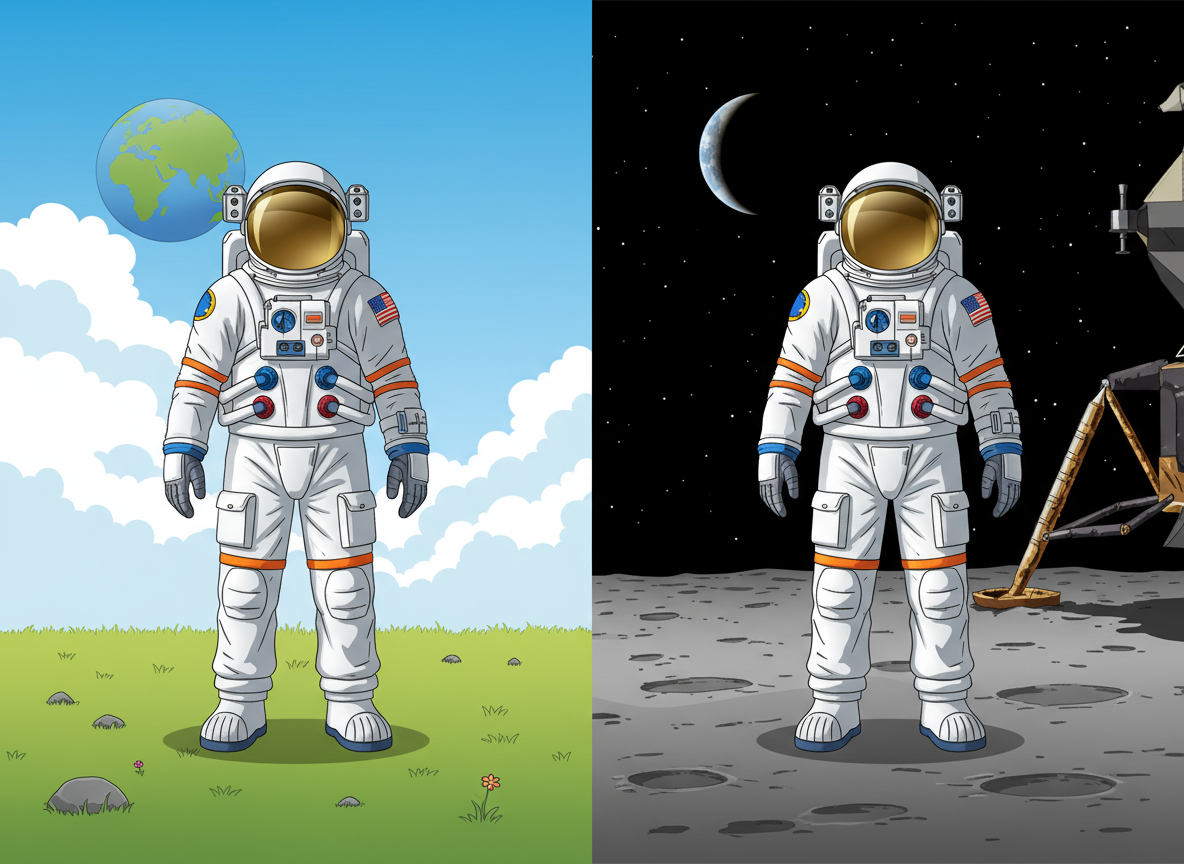
A spring-based bathroom scale designed to measure force would show about one-sixth of your Earth weight on the Moon—if it could operate and be calibrated for those conditions. Your mass would not change, but the Moon’s gravitational pull at the surface is only about 16.5% as strong as Earth’s.
Weight changes with gravity, mass does not
Mass describes the amount of matter in a body and its resistance to acceleration. Weight is the gravitational force on that body. In physics, weight is commonly calculated as mass multiplied by local gravitational acceleration (W = mg). Thus the same person has the same mass on Earth and on the Moon, but different weight.

NASA’s Moon fact sheet gives average surface gravity of about 1.62 m/s² on the Moon compared with about 9.80 m/s² on Earth. The ratio is 1.62 ÷ 9.80, or about 0.165.
What happens to the reading on a scale?
A traditional mechanical bathroom scale bends a spring or another force-sensitive mechanism in response to downward force. Its printed reading is calibrated for Earth gravity. If it functioned normally on the Moon, the same person would produce a smaller downward force, giving a much lower weight reading on the original Earth-calibrated markings.

Electronic bathroom scales often use load cells that also respond to force. Their display algorithms, calibration and environmental limits are model-specific, so a consumer scale might not work normally in vacuum or severe temperatures. The one-sixth rule explains the underlying physics; it is not a guarantee that an ordinary bathroom device will function on the lunar surface.
How to estimate a lunar scale reading
Multiply Earth weight by about 0.165, or divide by roughly six. For example, a scale that reads 120 lb on Earth would respond to the equivalent of about 19.8 lb of gravitational force on the Moon. A 180 lb Earth reading would correspond to approximately 29.7 lb. These are force-equivalent readings on an Earth-calibrated device, not changes in body mass.
Using the SI system, a person of 70 kg mass would experience about 686 newtons of weight on Earth but about 113 newtons on the Moon. Their mass remains 70 kg. Avoid saying they suddenly have only 11.6 kg of mass: that confuses kilograms of mass with a force-based scale’s reading.
Would an astronaut feel lighter?
Yes, lunar surface activities involve less gravitational support force than comparable Earth activities, but movement is not effortless. Astronauts still have inertia, bulky equipment and balance challenges. An object can be easier to lift against gravity but just as resistant to sudden acceleration or stopping.
For the related explanation, see Why Would You Weigh Less on the Moon but Have the Same Mass? and the Smithsonian’s Moon scale explanation.
Frequently asked questions
Would the scale show zero on the Moon? No. Lunar gravity is weaker, not zero.
Would a balance scale show the same mass? An equal-arm balance compares objects by gravity acting on both sides, so it can still compare masses in the same gravitational field.
Could I use an ordinary electric scale outside on the Moon? Do not assume so. Extreme temperatures, vacuum, power and calibration make ordinary Earth appliances unsuitable without engineering modifications.
What about on Mars? Surface gravity there is about 38% of Earth’s, so the same principle produces a lower reading than on Earth but higher than on the Moon.
Leave a Reply