
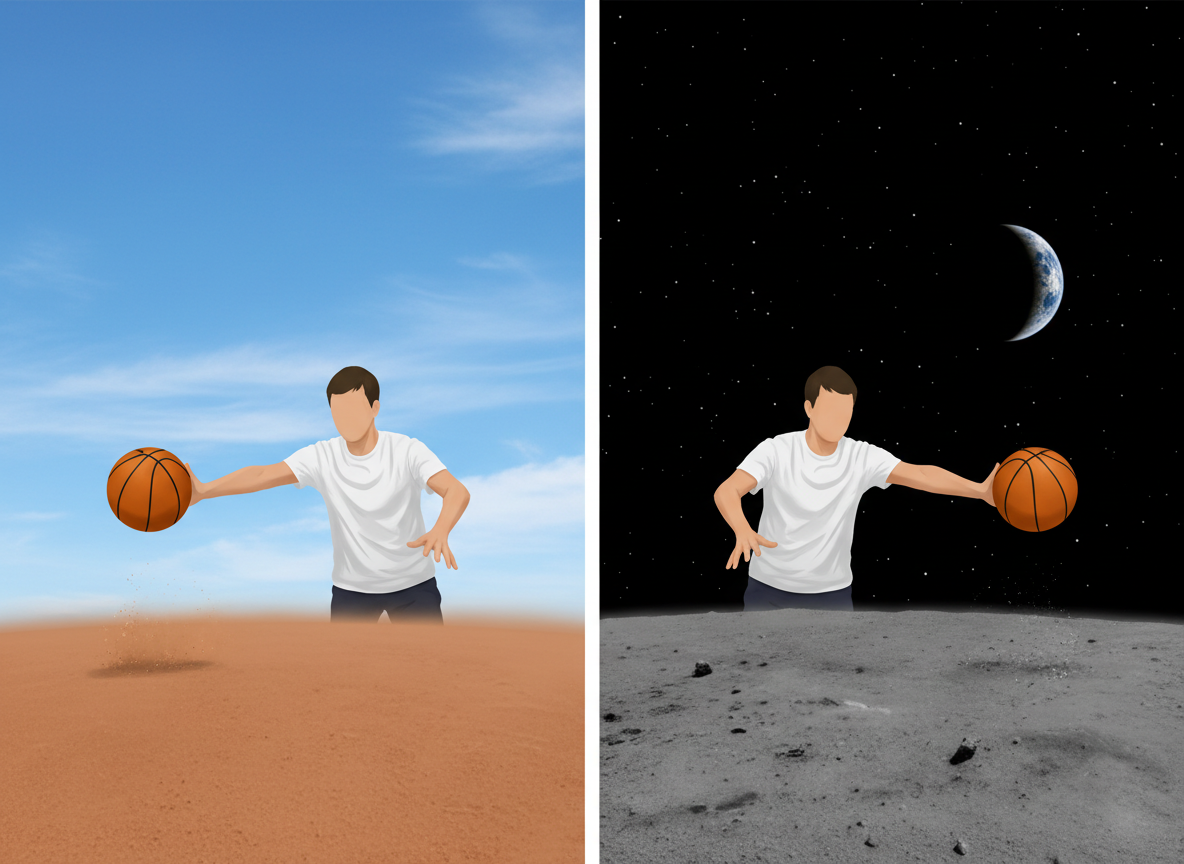
Not automatically. With identical ball behavior and the same drop height, weaker lunar gravity does not by itself make a bounce reach a larger fraction of its starting height. Bounces take longer on the Moon, while the real ball and lunar ground would change the comparison.
The important distinction: height versus time
Imagine the same ideal elastic ball dropped from the same height over equally firm ground on Earth and the Moon. Lunar gravity accelerates the ball less on the way down. It also slows the rising ball less on the way back up. In this simplified model, the ratio between rebound height and drop height is determined mostly by energy lost in the impact, not by gravitational strength alone.

Why a bounce would look slower
Near the lunar surface, gravity is about one-sixth of Earth’s. An otherwise similar dropped ball takes longer to hit the ground, and after it rebounds, it spends longer traveling upward and downward. A lower gravity setting makes the action look floaty, but that is not proof of a taller rebound in proportion to the original drop height.
A real basketball complicates the experiment
A normal basketball contains pressurized air. Because the Moon has almost no surrounding atmosphere, the ball experiences a much greater pressure difference than on Earth. Its shape, response and safety depend on the ball’s materials and inflation. Lunar dust and rock are also nothing like a polished indoor court, so real rebound heights cannot be predicted from gravity alone.

Try the useful Earth version
On a level hard court, drop one ball repeatedly from a marked height without pushing it, and observe the first rebound. Change the ball’s inflation or try different ground materials to see why impact properties matter. The Moon thought experiment then becomes a lesson in separating gravity from elasticity, air resistance, and surface conditions.
Frequently asked questions
Would the basketball weigh less on the Moon?
Yes. Its gravitational weight would be about one-sixth of its Earth weight, while its mass would stay the same.
Does a basketball need air to bounce?
Its internal gas pressure and elastic shell strongly influence bouncing, so a normal basketball may behave differently in near-vacuum.
Related reading: Why lunar gravity is one-sixth of Earth’s.
Sources and further reading: NASA: Moon gravity and atmosphere; NASA: The Moon’s thin exosphere.
Leave a Reply