
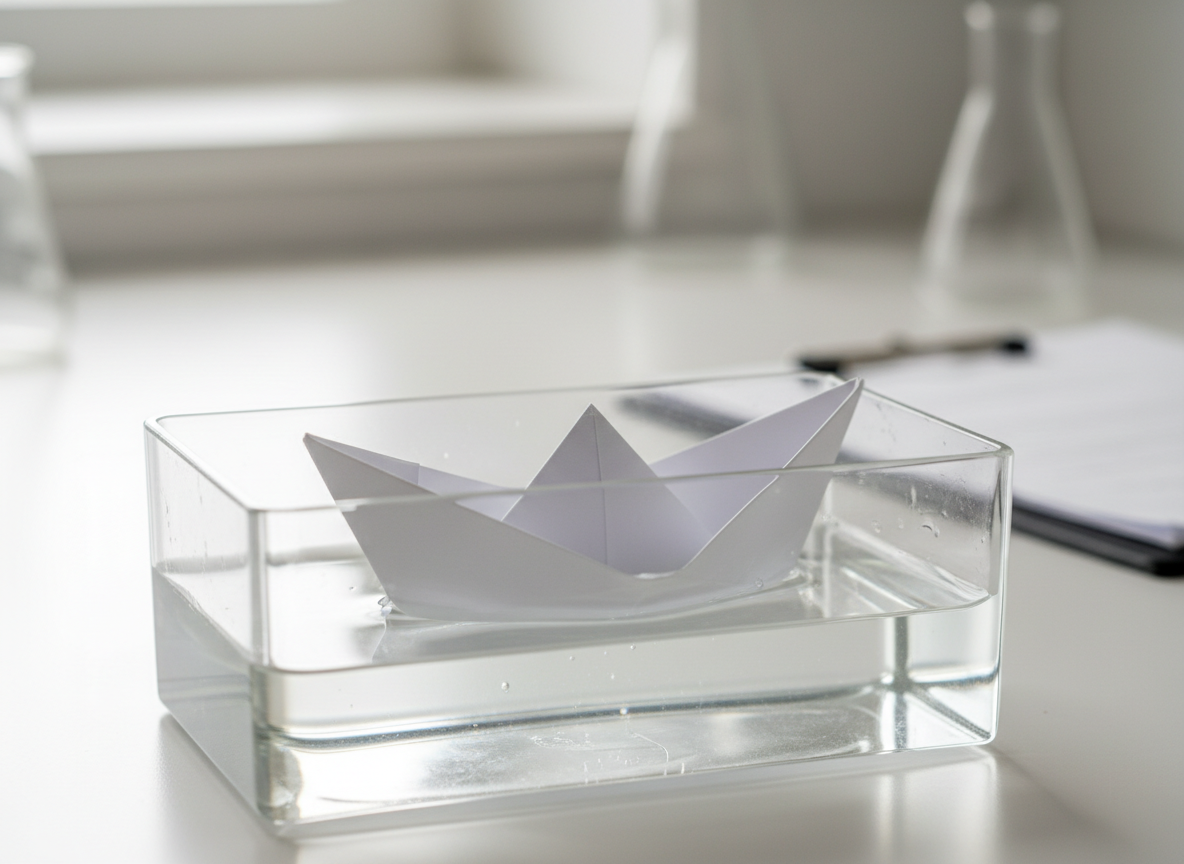
Quick answer: A folded paper boat can float because its shape displaces enough water to provide upward buoyant force. As paper absorbs water, the shape weakens and it may sink.
Buoyancy in plain language

Water pushes upward on submerged parts of the boat. If that buoyant force balances the boat’s total weight, it can float.
Shape matters
The open hull spreads weight across a volume of displaced water. A tightly crumpled wet paper ball behaves differently.
Why paper fails
Water moves into the fibers, making folds limp and changing how the hull holds its shape.
Try a fair test
Make two boats from equally sized sheets of different thicknesses, float them together and measure the time until each begins to sag.
What the experiment teaches
Floating depends on total weight, displaced water and hull geometry—not simply whether the material itself is “waterproof.”
The bottom line
A folded paper boat can float because its shape displaces enough water to provide upward buoyant force. As paper absorbs water, the shape weakens and it may sink.
Leave a Reply