
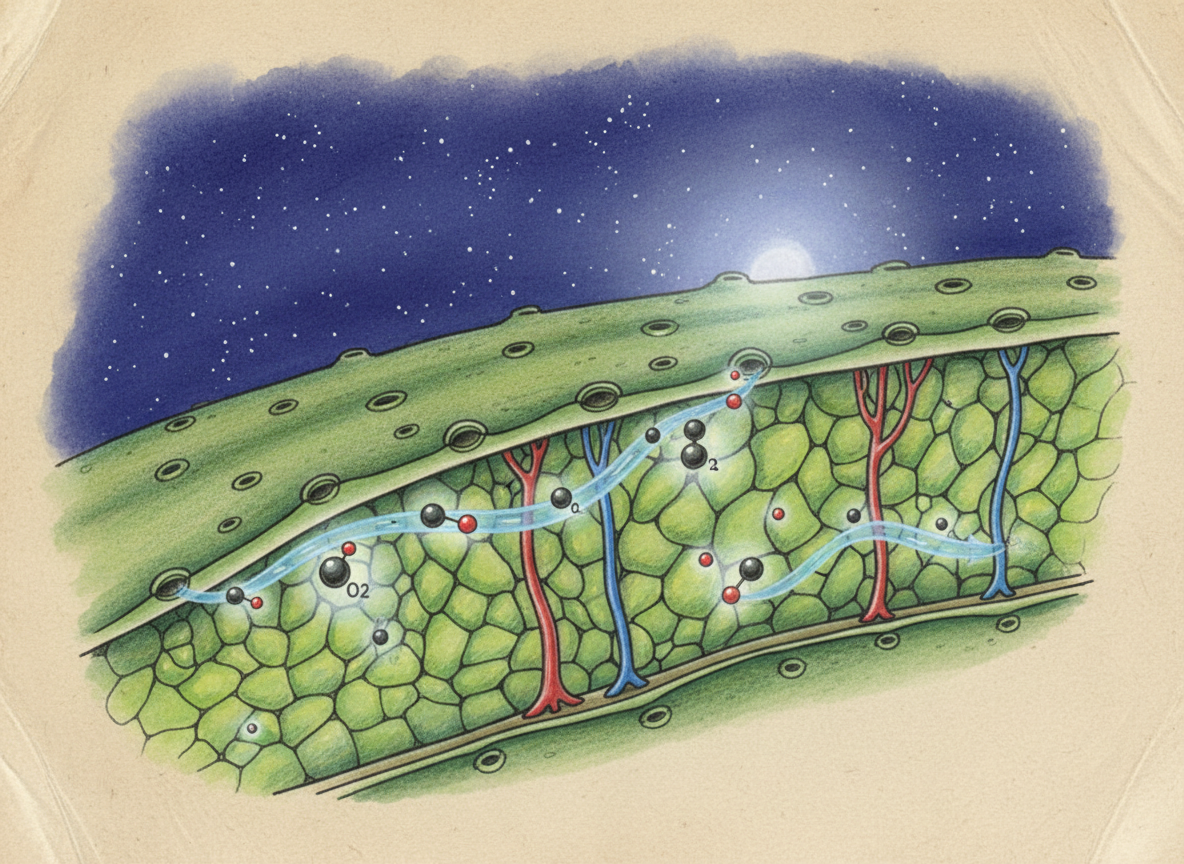
Some succulents take in carbon dioxide at night because they use a water-saving process called crassulacean acid metabolism, or CAM. They open tiny pores called stomata when the air is cooler, store the captured carbon in organic acids, and use it for photosynthesis during daylight.

Why open stomata at night?
For many plants, open stomata let carbon dioxide in but also allow water vapor to escape. In hot, dry conditions that can be costly. Night air is often cooler and more humid, reducing the water loss associated with gas exchange. CAM evolved as an adaptation that separates carbon collection from daytime sugar production.
What happens to the carbon dioxide overnight?
The captured carbon dioxide is incorporated into organic acids, especially malic acid, and stored in plant tissues. This nighttime chemical step is a form of carbon fixation, but it is not the same as completing the sunlight-driven production of sugar.
What happens when the Sun comes up?
During the day, many CAM plants close their stomata to conserve water. The stored organic acids release carbon dioxide inside the tissue, where it can be used in the Calvin cycle. The light-dependent reactions of photosynthesis still require light to supply energy. This is why ‘the cactus photosynthesizes only at night’ is an oversimplification.

Which plants use CAM?
CAM occurs in many cacti, certain agaves, pineapple, some orchids and other succulents. Not every thick-leaved plant uses CAM all the time; some species use it only in certain conditions. The familiar distinction is between ordinary C3 photosynthesis, where carbon is typically taken in by day, and CAM, which can shift much of that uptake into the night.
Does that make a cactus a ‘bedroom oxygen machine’?
No houseplant makes indoor air magically safe or replaces ventilation. Plant gas exchange is real, but the amounts from a typical potted plant are too small to treat as an air-quality solution. Choose plants for the light and care conditions they need, not claims about overnight oxygen production.
Frequently asked questions
Does CAM mean the plant needs no sunlight?
No. CAM plants still depend on light for the main energy-producing reactions of photosynthesis.
Are all succulents CAM plants?
No. Succulence describes water-storing tissues, while CAM describes a particular metabolic pathway. They often occur together but are not identical.
Do CAM plants keep stomata closed all day?
Many do under typical dry conditions, but the exact pattern can vary with species and environment, especially in plants capable of switching pathways.
Scientific references: Arizona State University explanation of CAM plants and Smithsonian Tropical Research Institute on CAM metabolism.
Leave a Reply