
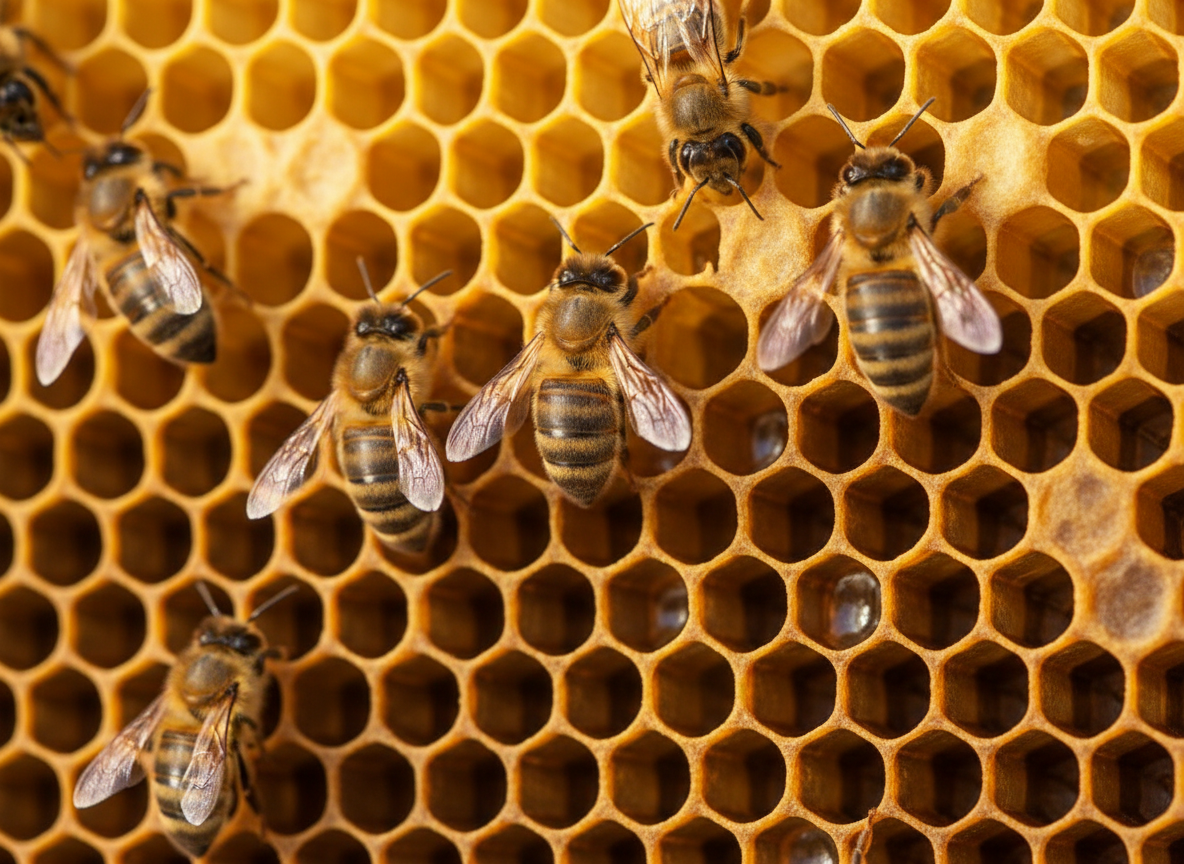
Honey bees fan their wings to help move air through the hive, encouraging water to evaporate from stored flower nectar. Evaporation is a major step in concentrating thin, watery nectar into thicker honey that the colony can store as food. Wing fanning is one part of a coordinated process that also involves transferring nectar between workers and adding enzymes.
Fresh nectar contains much more water than finished honey
Many flowers produce nectar that is mostly water with dissolved sugar. Honey needs to be far more concentrated. Worker bees collect nectar, transport it in a special crop often called the honey stomach, and share it with receiving workers back at the hive. Enzymes begin changing its sugars while water is removed.
The Purdue University Extension honey bee overview explains that nectar often contains roughly 60–80% water, compared with the much lower water content of finished honey. The percentages vary with flowers and environmental conditions.
How wing fanning helps evaporation

Bees can spread droplets of nectar and place them in wax cells while workers move air through the nest. When moist air is replaced with drier air, more water can evaporate from exposed nectar. Honey bees also manage hive temperature and ventilation for other reasons; wing fanning does not always mean they are making honey at that exact moment.
Evaporation depends on humidity, temperature and air movement. In humid weather the process can be slower, whereas drier moving air helps. The workers are not cooking the nectar or simply ‘drying it in the Sun’; most of the conversion happens in the hive.
How nectar changes into honey
- Foraging: A worker visits flowers and collects nectar.
- Transfer: Back at the hive, nectar is passed to other workers or placed into wax cells.
- Enzyme activity: Bee enzymes help transform some complex sugars into simpler sugars.
- Concentration: Water leaves the nectar as bees spread it and ventilate the hive.
- Storage: When the food has ripened sufficiently, workers can cap filled cells with wax.
Why bees cap the honeycomb

Wax cappings protect the contents of the cells. Capping generally indicates the colony considers the honey sufficiently ripened for storage, although moisture content and timing are not perfectly uniform. Honey is important food for adult workers and helps colonies survive periods when flowers are scarce.
For the entire sequence from a flower to stored food, explore How Do Bees Make Honey?. University of Arkansas Extension also describes how enzymes and evaporation work together.
What if bees couldn’t remove enough moisture?
Very watery nectar is not as convenient for long-term storage. Excess moisture in harvested honey can encourage fermentation by yeasts under the right conditions. That is one reason beekeepers pay close attention to the ripeness and moisture of honey; it is not a recommendation to open a hive or harvest it without training.
Frequently asked questions
Do bees make honey by blowing air directly on every cell? Not necessarily. Wing fanning helps circulate air through the hive; it is not a separate bee standing over every single cell.
Is nectar already honey when collected? No. Nectar is a starting material that workers process and concentrate.
Do bees fan only to make honey? No. They also fan for ventilation, temperature control and other colony functions.
Why is honey thick? It contains highly concentrated dissolved sugars and relatively little water compared with fresh nectar.
Leave a Reply