
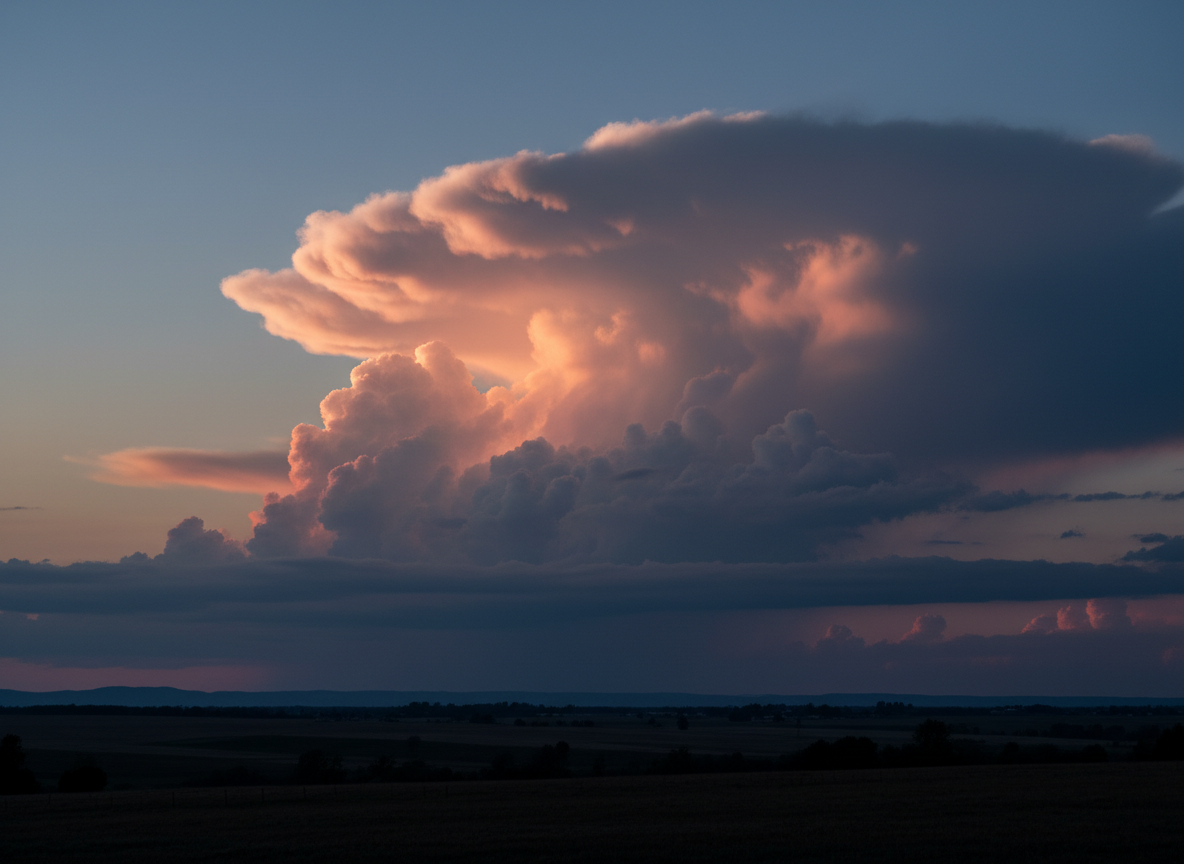
Clouds turn pink at sunrise and sunset because sunlight travels through a longer stretch of atmosphere, losing much of its blue and violet light along the way. The remaining sunlight is relatively rich in reds, oranges and pinks. Cloud droplets and ice crystals scatter that warm light toward your eyes, lighting the cloud from the side or below.

Why the light changes color
At midday, sunlight reaches you through a comparatively short path in the air. At a low solar angle, its journey is longer. Air molecules preferentially scatter shorter blue and violet wavelengths, a process known as Rayleigh scattering. That leaves relatively more of the longer-wavelength red and orange light continuing toward the horizon and into the cloud.
The cloud itself is not manufacturing pink light. Water droplets and ice crystals redirect the sunlight they receive. A cloud’s color depends on where the Sun is, which part of the cloud is lit, how thick the cloud is and how you are viewing it.
Why some clouds stay pink after sunset
High clouds can still be in direct sunlight when the Sun has already disappeared below the horizon for someone standing on the ground. That is why a streak of thin cirrus may glow pink above a dark landscape. Low clouds may be in Earth’s shadow sooner; tall clouds can show a glowing top over a dusky base.

Why do some clouds look purple, peach or bright red?
Color depends on the mix of warm sunlight, blue light scattered through the rest of the sky, the thickness of the cloud, and particles in the air. Pink often looks stronger against a cooler blue background. Dust, smoke and haze can change sunset colors, but spectacular pink clouds can appear in perfectly ordinary clean-air conditions.
Clouds may also look gray despite a colorful sky if they are very thick or have already entered shadow. It is common to see pink upper edges and blue-gray undersides on the same cloud.
How to spot the effect
- Look toward clouds near the horizon shortly before and after sunset, but never stare directly at the Sun.
- Compare the tops and bottoms of a tall cloud: they may be lit differently.
- Look for thin, high clouds that remain colored while the landscape darkens.
- Take two photos several minutes apart; the colors can change quickly as the Sun drops.
Frequently asked questions
Do pink clouds mean rain is coming?
No. Pink is primarily an effect of illumination, not a reliable rain forecast. Watch cloud type, wind, radar and local forecasts instead.
Are pink clouds only seen at sunset?
No. The same basic lighting effect occurs near sunrise when sunlight also takes a long route through the atmosphere.
Why does the same cloud turn gray minutes later?
As the Sun moves lower, its direct rays can stop reaching that portion of the cloud. In shadow, the cloud reflects less warm light and may appear gray or blue.
For more about the scattering that causes sunset colors, see the National Weather Service explanation of sky colors.
Leave a Reply