
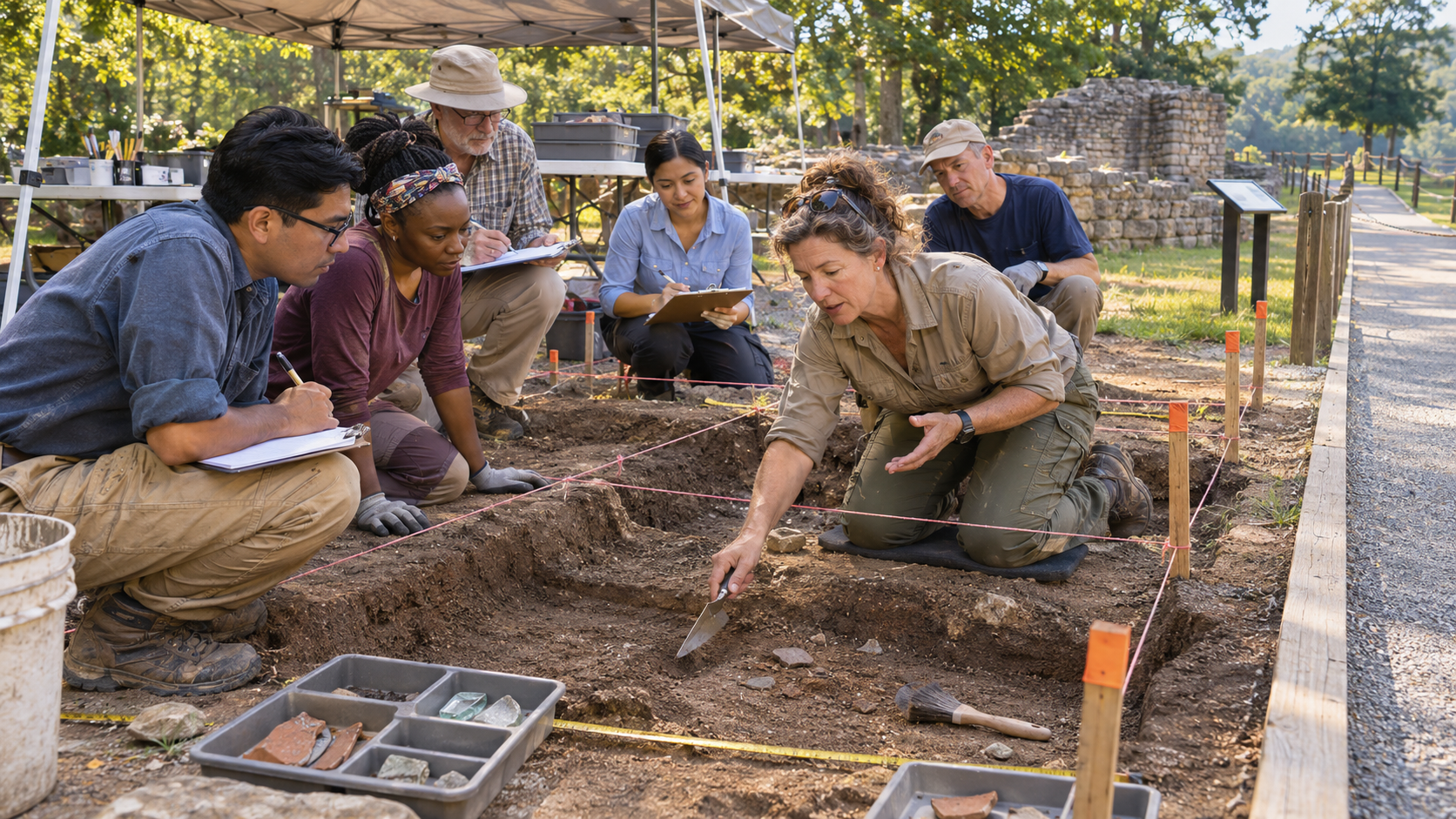
Start with the National Park Service archaeology volunteer page, your state archaeologist or archaeological society, the U.S. Forest Service’s Passport in Time program, and the Archaeological Institute of America fieldwork directory. For a first experience, also search local universities, museums, historical societies and state Archaeology Month calendars for supervised site tours, artifact-processing days, public lab sessions and beginner field schools. Never dig, collect or metal-detect at an archaeological site without explicit authorization.

What counts as a public archaeology program?
Public archaeology connects professional archaeological work with communities. A program might invite volunteers to help with a supervised survey or excavation, wash and catalog artifacts in a laboratory, transcribe records, monitor threatened sites, attend a behind-the-scenes tour, or learn preservation skills. A legitimate program explains who directs the work, whose land and heritage are involved, what volunteers may do, and what happens to the records and objects afterward.
Excavation is only one part of archaeology. Many useful beginner roles happen in labs, archives, museums and public education. If kneeling, heat, travel or rough terrain are barriers, ask about seated artifact processing, data entry, collections photography, research, interpretation or remote transcription.
Search National Park Service opportunities
The National Park Service volunteering guide points people to park volunteer opportunities and recommends searching both “archaeology” and the federal spelling “archeology.” Possible assignments include collections work, research, data entry, tours and citizen-science tasks. The separate NPS citizen-science page also recommends contacting a park directly to ask whether archaeologists need help.
Open the individual park’s official page and verify the season, physical requirements, application deadline, housing or transportation expectations and minimum age. A national information page proves that the program exists, not that every park has an active opening today.
Look for Passport in Time and other federal programs
Passport in Time is a U.S. Forest Service volunteer archaeology and historic-preservation program. According to the Advisory Council on Historic Preservation, projects can include surveys, excavations, archival research, oral histories, historic-structure work and artifact analysis. Search the current Passport in Time project listings and follow the application instructions for the specific project rather than arriving at a site on your own.
The National Park Service also directs volunteers toward federal opportunities, including the Bureau of Land Management and the Forest Service. Openings vary by place and season, and some fill quickly. Check whether camping, meals, tools or protective equipment are supplied and whether volunteers must pay their own travel expenses.
Contact your state archaeologist and archaeological society
The Society for American Archaeology’s local-involvement guide recommends state archaeologists, State Historic Preservation Offices and state archaeological societies as starting points. These organizations may know about chapter meetings, training excavations, site-steward programs, lab days and public talks that never appear in a national directory.
Search “state archaeologist” or “State Historic Preservation Office” with your state, then confirm that the page is an official government or recognized society site. Wondelique’s guide to finding local history societies can help you identify nearby institutions, but ask whether any archaeology activity is supervised by qualified professionals.
Use Archaeology Month and International Archaeology Day
Many states hold an Archaeology Week or Archaeology Month. The SAA state-celebrations directory describes common events such as site and laboratory tours, lectures, mapping demonstrations, flintknapping demonstrations and sample excavation experiences. These are often the easiest low-commitment way to meet local archaeologists and learn what ongoing volunteer work is available.
The Archaeological Institute of America also coordinates International Archaeology Day activities through local societies and partner institutions. Verify the year, host and registration details on the organizer’s current event page; an old festival listing can remain searchable long after the event ends.
Search reputable fieldwork directories carefully
The AIA fieldwork page links to a large directory of archaeological projects. Listings can include age limits, experience requirements, academic credit, accommodations and costs. Some projects are volunteer opportunities; others are paid field schools or programs that charge fees for instruction, lodging or meals.
Before paying, confirm the director’s institutional affiliation, permits, landowner authorization, research plan, refund policy, insurance expectations and where recovered materials will be curated. A high price does not guarantee ethical or educational quality. Do not assume “volunteer” means free, and do not send money merely to receive a secret location.
Check public-archaeology centers, universities and museums
The SAA list of public-archaeology centers identifies regional organizations that focus on education, community dialogue, research and stewardship. Use it as a lead, then open each center’s own calendar to see whether it currently accepts volunteers or offers public events.
- Universities: search archaeology, anthropology, classics, history and public-humanities calendars for “community archaeology,” “field school,” “open lab” and “volunteer.”
- Museums: look for collections volunteers, object documentation, family archaeology days and curator talks.
- Historical societies: ask about supervised cemetery documentation, building surveys, archives and oral-history projects—not unauthorized digging.
- Tribal historic-preservation offices and Indigenous museums: follow the community’s public guidance and do not expect access to sensitive sites, knowledge or ancestral materials.
If you prefer interpretation and visitor education, museum docent work may be a better fit than field excavation. For research skills that overlap with archives and records, see Wondelique’s guide to finding genealogy workshops.
How to evaluate a program before joining
- Named supervision: a qualified archaeologist or established institution directs the work.
- Permission and permits: the organizer can explain who authorized the project and what laws apply.
- Training: beginners receive instruction in context, recording, tool use and safety before touching a site or collection.
- Stewardship: artifacts, notes, photographs and samples go to an identified repository; volunteers do not keep finds.
- Respect: the program has procedures for Indigenous consultation, human remains, sacred places and descendant communities.
- Clear logistics: age, accessibility, weather, clothing, insurance, costs, cancellation and transportation are stated in writing.
Questions to ask about accessibility and safety
Ask how far participants walk, whether the route is level, how long people kneel or stand, what shade and water are available, whether there are accessible restrooms, and whether a seated or indoor role is available. Field conditions can include heat, insects, sharp tools, unstable ground and limited cell service. Tell the coordinator about accommodation needs before the project day so the assignment can be planned safely.
Also ask what happens during severe weather, who provides first aid, whether volunteers work alone, and what personal protective equipment is required. Wondelique’s guide to volunteer trail crews has additional questions for outdoor volunteer logistics.
Red flags that suggest looting or unethical work
- Participants are allowed to keep, trade or sell artifacts.
- The organizer will not identify the landowner, permit, professional supervisor or repository.
- The project encourages unsupervised digging, arrowhead hunting or metal detecting at protected sites.
- Precise site locations are posted publicly without a preservation reason.
- Human remains, burials or sacred objects are treated as attractions.
- Speed, treasure or monetary value matters more than documentation and context.
Archaeological context is destroyed when an object is removed without recording its exact location and relationships. If you accidentally encounter possible artifacts or remains, leave them in place, avoid sharing the location publicly and contact the land manager, state archaeologist or law enforcement as appropriate.
Quick answer
For ethical public archaeology, search NPS volunteer listings, Passport in Time, your state archaeologist and archaeological society, state Archaeology Month events, public-archaeology centers and the AIA fieldwork directory. Verify the current date, supervision, authorization, costs, accessibility and curation plan. Choose a program that trains volunteers and protects sites rather than one that promises treasure or lets participants keep finds.
Sources and verification
This guide was verified November 11, 2026, using the National Park Service, the Advisory Council on Historic Preservation, the Society for American Archaeology’s avocational archaeology guide, state archaeology celebrations and public-archaeology centers, plus the Archaeological Institute of America fieldwork resource. Opportunities and rules change; verify the specific program directly.
Leave a Reply