
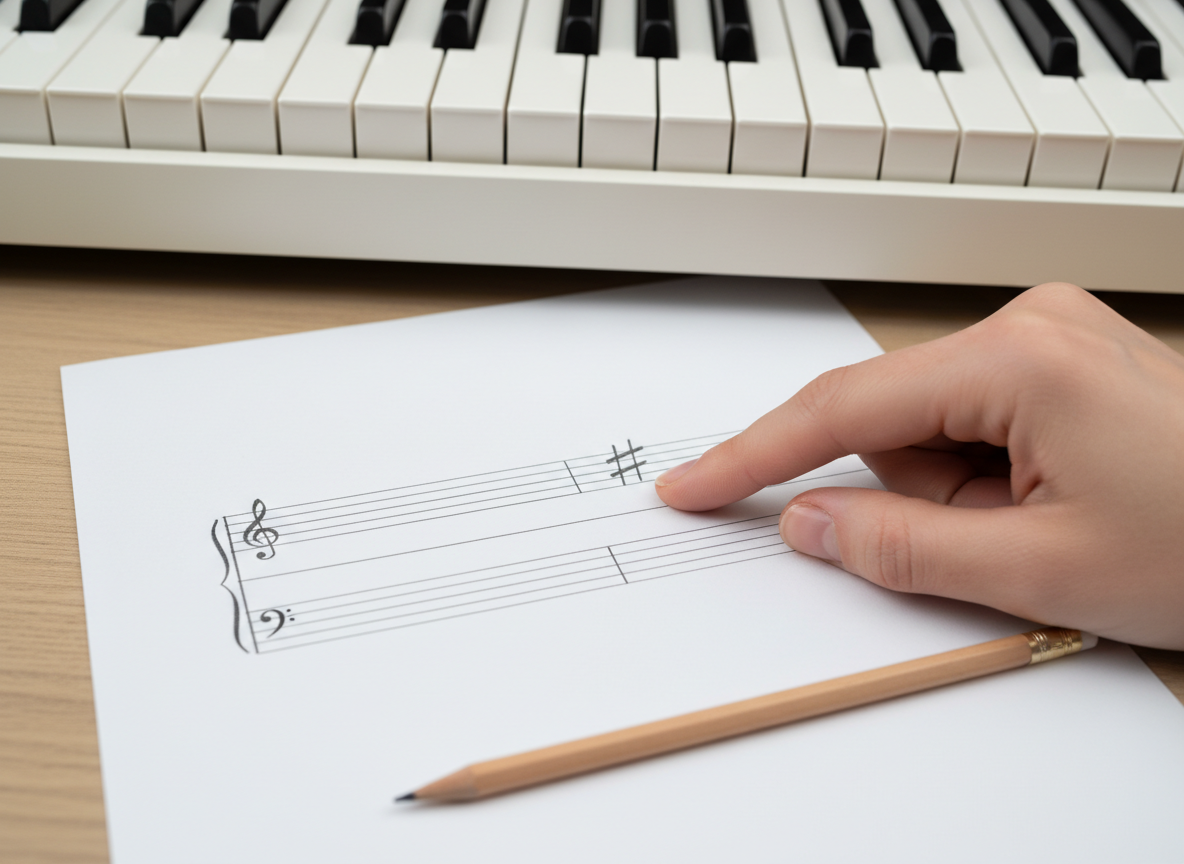
One sharp at the beginning of a staff means written F notes are normally played as F-sharp rather than F-natural unless a later accidental changes them. The key signature belongs to G major or its relative minor, E minor; the melody and harmony help distinguish which key it is.
Find the sharp after the clef
In common written music, the key signature sits between the clef and time signature. One sharp symbol is placed at the position for F. The sign applies to all written F notes in the relevant staff octaves until the key signature changes or a local accidental overrides it.

Where F-sharp is on a piano
Find any group of three black keys. F-sharp is the first black key in that group, immediately to the right of F. If the music asks for F-sharp, play that black key instead of the F white key. Do not change every note with the letter G or C—only F is sharpened by this signature.
Practice the G major scale
Start on G and play G, A, B, C, D, E, F-sharp, G. Move slowly enough to hear each note, then reverse. The scale sounds like a familiar major scale because it preserves the whole-step and half-step pattern of a major key. Learn one octave before trying both hands together.

G major and E minor use the same signature
A piece with one sharp can be in G major or E minor. The final chord, tonal center and phrase shapes usually provide better clues than the signature alone. Beginners can focus first on playing the F-sharp correctly; deeper key analysis can come later.
Frequently asked questions
Does one sharp mean every F note is sharp?
Normally yes within the staff it governs, unless a natural or another accidental changes a specific note in context.
What if I see F-natural later?
A natural sign cancels the sharp for that note under the usual accidental rules of the measure.
Related reading: How to count a three-beat waltz on piano.
Leave a Reply