
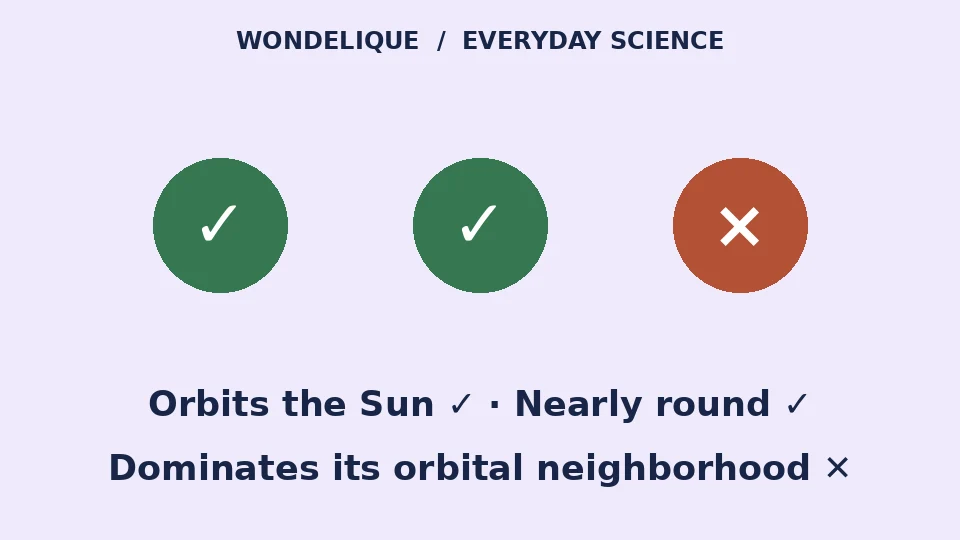
In the International Astronomical Union’s 2006 Solar System definition, a planet must orbit the Sun, be nearly round and have cleared its orbital neighborhood. ‘Cleared’ means gravitationally dominating that region—not sweeping away every last rock.
Gravity decides the neighborhood
A massive world can accrete, scatter or gravitationally control nearby smaller bodies over long timescales. Earth still has near-Earth asteroids and shares regions of space with other objects, but it gravitationally dominates its orbit.
Why Pluto falls short
Pluto occupies the Kuiper Belt, a region containing many icy bodies on related Sun-orbiting paths. It is round and orbits the Sun, but it has not become gravitationally dominant in the same sense as the eight major planets.
How that created a new category
The IAU definition classifies Pluto as a dwarf planet. Other officially recognized examples include Ceres, Eris, Haumea and Makemake. ‘Dwarf planet’ does not mean Pluto is scientifically unimportant or that scientists stopped studying it.
Why people still debate the rule
Some planetary scientists prefer definitions focused on an object’s physical properties rather than its orbital setting. These viewpoints reflect a real debate about classification, but the IAU rule explains current conventional lists of eight planets.
Frequently asked question
Does clearing an orbit require zero asteroids?
No. It describes orbital dominance over time, not an absolutely empty path.
Source and further reading
See the NASA reference for additional scientific background.
Leave a Reply