
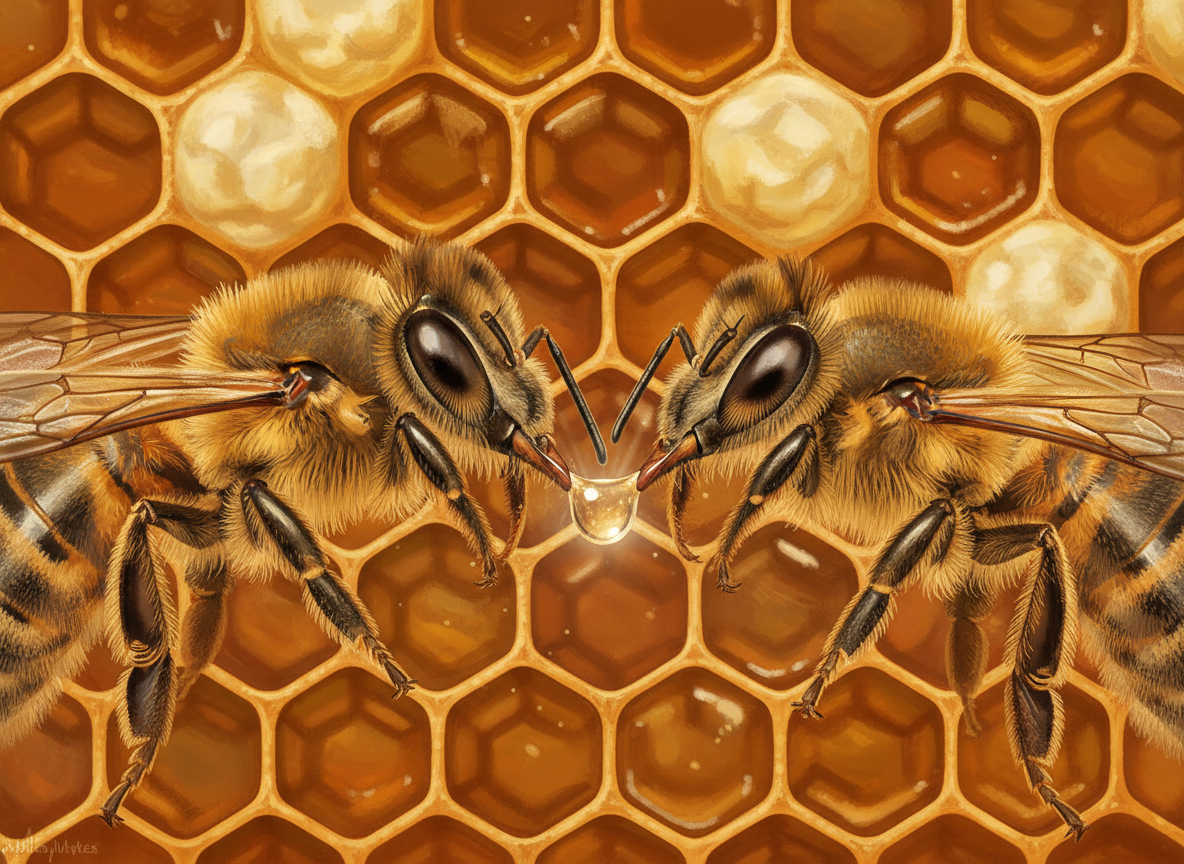
Honeybees add enzymes while moving nectar through the colony. Invertase helps split sucrose into simpler sugars, and glucose oxidase contributes compounds associated with honey’s acidity and antimicrobial properties. Drying the nectar remains just as important.
Enzymes begin working before a cell is capped
Foragers collect sugary flower nectar in the honey stomach and transfer it to receiver bees. During collection and sharing, nectar contacts bee-secreted enzymes. These are biological catalysts: they help chemical reactions happen without functioning as a separate secret added at the end.

Invertase changes the sugar mixture
Nectar often contains sucrose. An enzyme called invertase helps break sucrose into the two simpler sugars glucose and fructose. Exact nectar chemistry varies by flower, so finished honey is not identical from one source to another. Enzymes do not turn the nectar into a sugar-free product; honey remains primarily a concentrated sugar food.
Glucose oxidase contributes other chemistry
Another bee enzyme, glucose oxidase, helps convert some glucose into gluconic acid and hydrogen peroxide under suitable conditions. Honey’s low water content, sugar concentration and acidity all contribute to its resistance to spoilage. That does not make ordinary honey sterile or an appropriate substitute for medical wound care.

Water removal completes a crucial part of the process
Workers spread nectar in cells and move air through the hive to evaporate water. As honey concentrates, it becomes less hospitable to many microorganisms. Workers usually cap cells once the honey is suitable for storage. The timing varies with weather, nectar input and the colony.
Frequently asked questions
Are the enzymes the only reason honey keeps well?
No. Sugar concentration, acidity and reduced available water also matter greatly.
Is honey safe for babies?
No. The CDC advises against giving honey to children younger than 12 months because it can contain botulism spores, despite honey’s other antimicrobial characteristics.
Related reading: What changes when nectar becomes honey.
Sources and further reading: Purdue Extension on nectar and honey enzymes; Mississippi State Extension on honey making; CDC: Avoid honey before age 12 months.
Leave a Reply