
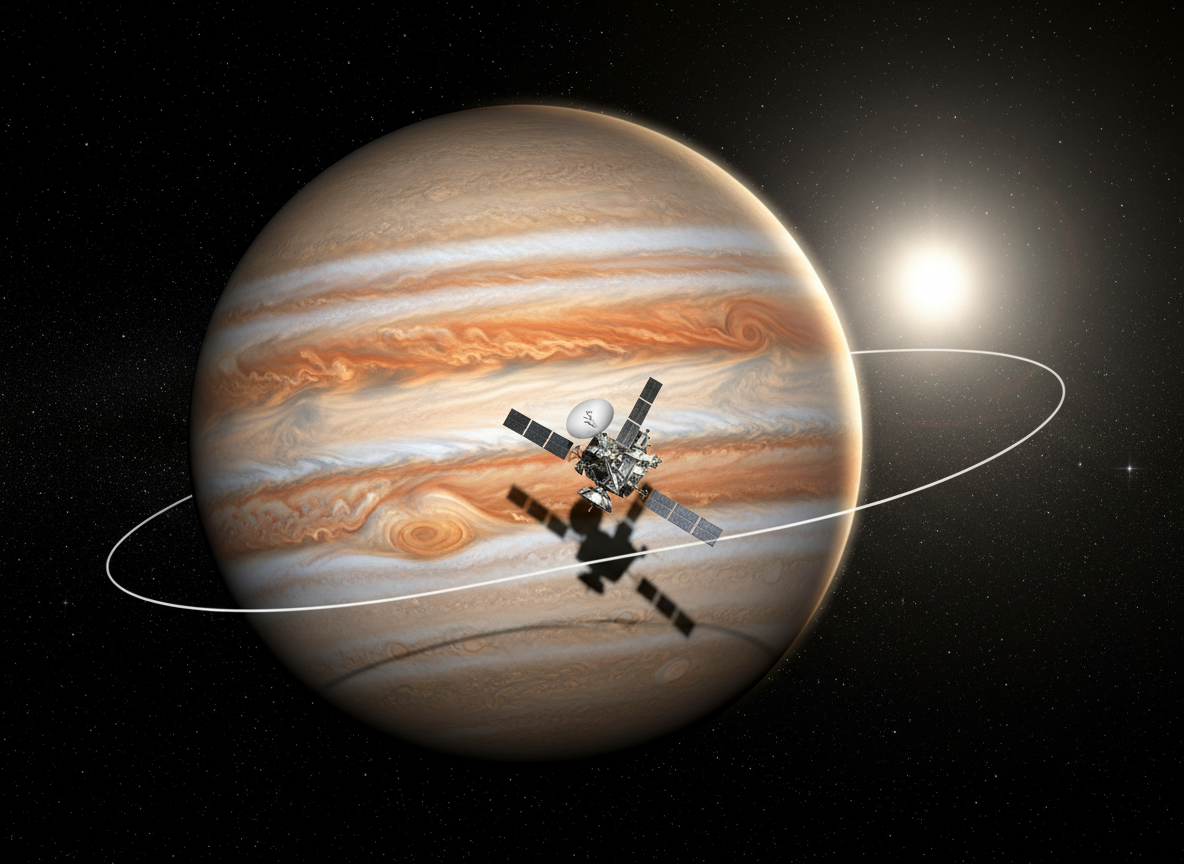
A gravity assist is a carefully planned flyby in which a spacecraft uses a moving planet or moon to change its speed and direction relative to the Sun or another central body. The maneuver can save propellant and make a distant mission possible. It can also slow a spacecraft down, depending on which side it passes.

What actually gives the spacecraft a boost?
A planet is not sitting still. It is orbiting the Sun, carrying enormous momentum. As a spacecraft approaches, the planet’s gravity bends its flight path. From the planet’s own frame of reference, the spacecraft generally approaches and departs a distant unpowered flyby at approximately the same speed, although its direction changes. From the Sun’s point of view, the planet is moving, so that change in direction can produce a different spacecraft speed.
Think of a fast-moving train deflecting a rolling ball without the ball bouncing off its surface: motion matters, not just the strength of the pull. This is an analogy, not a literal collision. In space the spacecraft never needs to touch the planet.
A simple step-by-step flyby
- Mission planners choose an exact arrival time and path past the target planet or moon.
- As the spacecraft approaches, gravity curves its trajectory and accelerates it toward the body.
- After closest approach, gravity bends its path again and slows its speed relative to that body as it moves away.
- Because the planet or moon itself is moving, the departing spacecraft can gain or lose speed in the larger Sun-centered or planet-centered system.

Does a gravity assist create free energy?
No. Energy and momentum are conserved. When a spacecraft gains a tiny amount of orbital energy, the moving planet exchanges an opposite amount. A planet is so vastly more massive that its orbital change is essentially imperceptible. The trade allows the spacecraft to save the propellant it otherwise would have burned.
Can a gravity assist also slow a spacecraft?
Yes. The timing and geometry determine whether a flyby adds or subtracts speed relative to the central body. Missions sometimes need to lose orbital energy to reach an inner destination or enter a desired orbit. A flyby may also change inclination—the angle of the spacecraft’s orbit—without a large engine burn.
Real missions that used gravity assists
NASA’s Cassini spacecraft flew past Venus twice, then Earth and Jupiter, on its way to Saturn. NASA’s Voyager 2 used planetary flybys during its journey to the outer planets. These encounters were computed and navigated precisely, not opportunistic close calls.
Frequently asked questions
Does the spacecraft use its engine during a gravity assist?
The main speed change comes from gravitational interaction rather than a large propulsion burn. Small trajectory-correction burns can still be used before or after the encounter.
Is a slingshot the same thing?
People often call a gravity assist a gravitational slingshot. It is a useful nickname, but the important physical explanation is momentum exchange with a moving gravitating body.
Can a moon provide a gravity assist?
Yes. Cassini repeatedly used flybys of Saturn’s moon Titan to reshape its orbit around Saturn.
Sources: NASA’s explanation of Cassini gravity assists and NASA’s gravity-assist primer.
Leave a Reply