
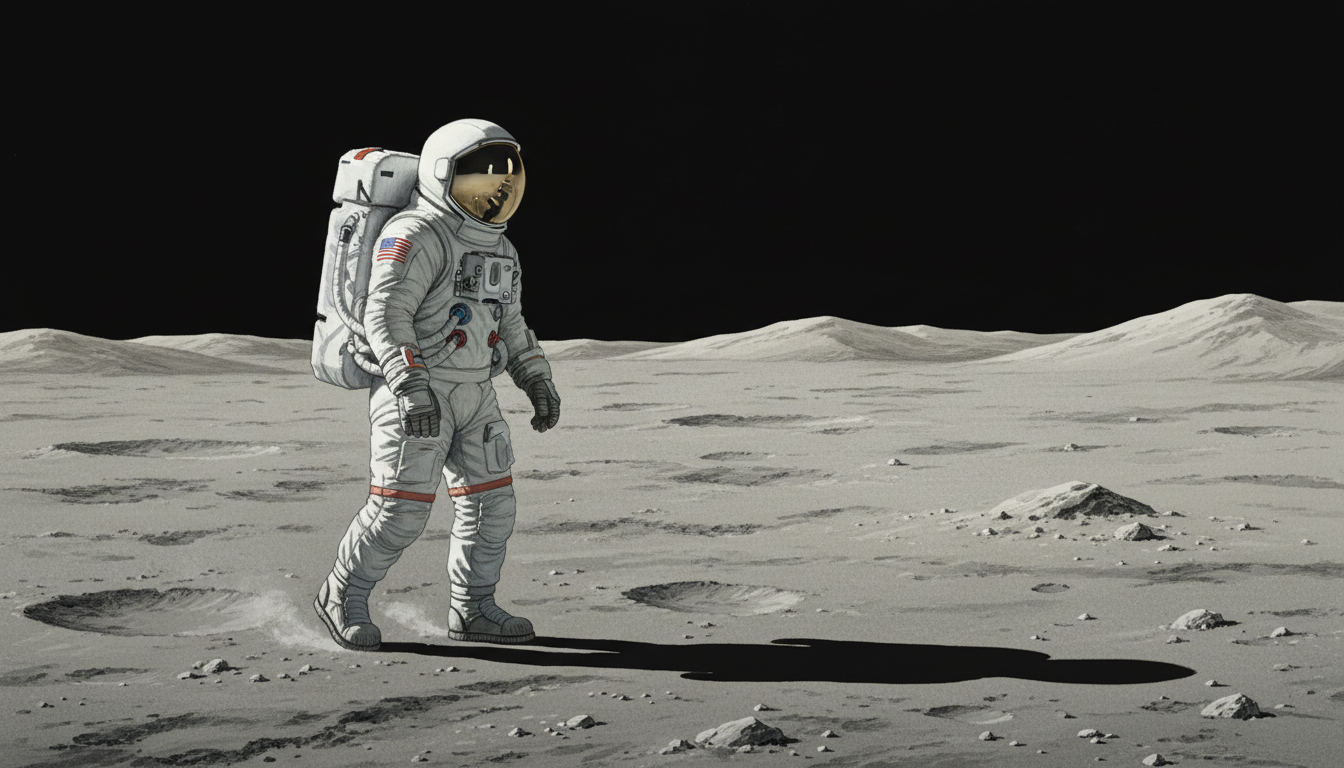
Yes, a spacesuit adds mass and therefore adds weight to an astronaut on the Moon. But because lunar gravity is about one-sixth of Earth’s, the combined astronaut-and-suit system weighs much less on the Moon than it would on Earth. The equipment is still bulky and has inertia, so moving it is not effortless.

What changes on the Moon—and what does not?
- Mass stays nearly the same: the amount of matter in the astronaut and suit does not disappear when gravity changes.
- Weight force gets smaller: lunar surface gravity is about 1.62 m/s² compared with about 9.81 m/s² on Earth.
- Inertia remains: speeding up, slowing down and changing direction still require effort.
- Suit pressure resists bending: the pressurized structure can make certain movements harder even in lower gravity.
A simple example: person plus equipment
Imagine an astronaut with an Earth-weight-equivalent of 180 pounds and equipment that would weigh 180 pounds on Earth. Combined, they would register roughly 360 pounds-force under Earth’s gravity. At the Moon’s surface the equivalent would be about 60 pounds-force—one-sixth as much—but the mass of the person plus equipment would still be unchanged. This is an illustrative arithmetic example, not a specification for any modern suit.
The exact factor is a little more precise than one-sixth, and the result depends on local gravitational acceleration. For the full calculation, see how to calculate your Moon weight.

Why was walking still awkward for Apollo astronauts?
Low gravity changes balance, while the suit limits joint mobility and the backpack shifts mass distribution. Walking, hopping and regaining balance require control. The astronaut must also contend with uneven terrain and lunar dust; the low weight does not remove the need to accelerate or stop a large mass.
How heavy were Apollo-era suits?
The Smithsonian National Air and Space Museum explains that Neil Armstrong’s suit alone was about 76 pounds under Earth gravity, and a fully equipped configuration with life-support and oxygen systems could be much heavier. See the museum’s Armstrong spacesuit explanation for how the equipment was built and worn. Actual mass and configuration changed by mission and gear.
Would a bathroom scale show the right number?
A typical Earth-calibrated bathroom scale is designed for Earth’s gravitational acceleration. On the Moon, its reading or operation may not represent the astronaut’s Earth-weight-equivalent without suitable calibration. The underlying weight force is lower, but the scale design matters. See whether a bathroom scale works on the Moon.
Frequently asked questions
Does a spacesuit cancel out the Moon’s low gravity?
No. Every kilogram of suit adds mass, yet lunar gravity still acts on the entire system at about one-sixth Earth’s strength.
Can astronauts jump six times as high?
Not necessarily. Jump height also depends on launch speed, suit stiffness, balance and practical safety limits. Lower gravity alone does not guarantee a sixfold jump height in real life.
Would a heavier backpack feel light on the Moon?
Its gravitational pull would be lower, but its inertia would be unchanged. Sudden turns and stops can still feel cumbersome.
Would the same suit be easier to wear in orbit?
In orbit, the suit and astronaut experience continuous free fall, so apparent weight behaves differently. Pressurization and inertia still constrain movement.
Leave a Reply